Showing posts with label Drought. Show all posts

Friday, June 7, 2013

NASA’s Startling Satellite Data Shows Massive Drop In Mideast Freshwater Reserves During Warming-Driven Drought

Variations in total water storage from normal in the Tigris and Euphrates river basins (from 1/03 through 12/09), as measured by NASA’s GRACE satellites (Full image here).

By Alan Buis, Steve Cole, and Janet Wilson, via NASA

A new study using data from a pair of gravity-measuring NASA satellites finds that large parts of the arid Middle East region lost freshwater reserves rapidly during the past decade.

Scientists at the University of California, Irvine; NASA’s Goddard Space Flight Center in Greenbelt, Md.; and the National Center for Atmospheric Research in Boulder, Colo., found during a seven-year period beginning in 2003 that parts of Turkey, Syria, Iraq and Iran along the Tigris and Euphrates river basins lost 117 million acre feet (144 cubic kilometers) of total stored freshwater. That is almost the amount of water in the Dead Sea. The researchers attribute about 60 percent of the loss to pumping of groundwater from underground reservoirs.

The findings … published Friday, Feb. 15, in the journal Water Resources Research, are the result of one of the first comprehensive hydrological assessments of the entire Tigris-Euphrates-Western Iran region. Because obtaining ground-based data in the area is difficult, satellite data, such as those from NASA’s twin Gravity Recovery and Climate Experiment (GRACE) satellites, are essential. GRACE is providing a global picture of water storage trends and is invaluable when hydrologic observations are not routinely collected or shared beyond political boundaries.

GRACE data show an alarming rate of decrease in total water storage in the Tigris and Euphrates river basins, which currently have the second fastest rate of groundwater storage loss on Earth, after India,” said Jay Famiglietti, principal investigator of the study and a hydrologist and professor at UC Irvine. “The rate was especially striking after the 2007 drought. Meanwhile, demand for freshwater continues to rise, and the region does not coordinate its water management because of different interpretations of international laws.”

Famiglietti said GRACE is like having a giant scale in the sky. Within a given region, rising or falling water reserves alter Earth’s mass, influencing how strong the local gravitational attraction is. By periodically measuring gravity regionally, GRACE tells us how much each region’s water storage changes over time.

“GRACE really is the only way we can estimate groundwater storage changes from space right now,” Famiglietti said.

The team calculated about one-fifth of the observed water losses resulted from soil drying up and snowpack shrinking, partly in response to the 2007 drought. Loss of surface water from lakes and reservoirs accounted for about another fifth of the losses. The majority of the water lost — approximately 73 million acre feet (90 cubic kilometers) — was due to reductions in groundwater.

“That’s enough water to meet the needs of tens of millions to more than a hundred million people in the region each year, depending on regional water use standards and availability,” said Famiglietti.

Famiglietti said when a drought reduces an available surface water supply, irrigators and other water users turn to groundwater supplies. For example, the Iraqi government drilled about 1,000 wells in response to the 2007 drought, a number that does not include the numerous private wells landowners also very likely drilled.

“Water management is a complex issue in the Middle East — an area that already is dealing with limited water resources and competing stakeholders,” said Kate Voss, lead author of the study and a water policy fellow with the University of California’s Center for Hydrological Modeling in Irvine, which Famiglietti directs.

“The Middle East just does not have that much water to begin with, and it’s a part of the world that will be experiencing less rainfall with climate change,” said Famiglietti. “Those dry areas are getting dryer. The Middle East and the world’s other arid regions need to manage available water resources as best they can.”

Study co-author Matt Rodell of Goddard added it is important to remember groundwater is being extracted unsustainably in parts of the United States, as well.

“Groundwater is like your savings account,” Rodell said. “It’s okay to draw it down when you need it, but if it’s not replenished, eventually it will be gone.”

GRACE is a joint mission with the German Aerospace Center and the German Research Center for Geosciences, in partnership with the University of Texas at Austin. NASA’s Jet Propulsion Laboratory, Pasadena, Calif., developed the GRACE spacecraft and manages the mission for NASA’s Science Mission Directorate, Washington. For more about GRACE, visit: http://www.nasa.gov/grace and http://www.csr.utexas.edu/grace.

– This piece originally appeared at NASA.gov.

Related Post:

Reds and oranges highlight lands around the Mediterranean that experienced significantly drier winters during 1971-2010 than the comparison period of 1902-2010.

jQuery(document).ready(function(){jQuery('#comment_submit').click(function(){if(jQuery('#comment_check:checked').length

View the original article here

Monday, April 29, 2013

Dust Bowl Days: Historic U.S. Drought Projected To Persist For Months, Worsened By Thin Western Snowpack

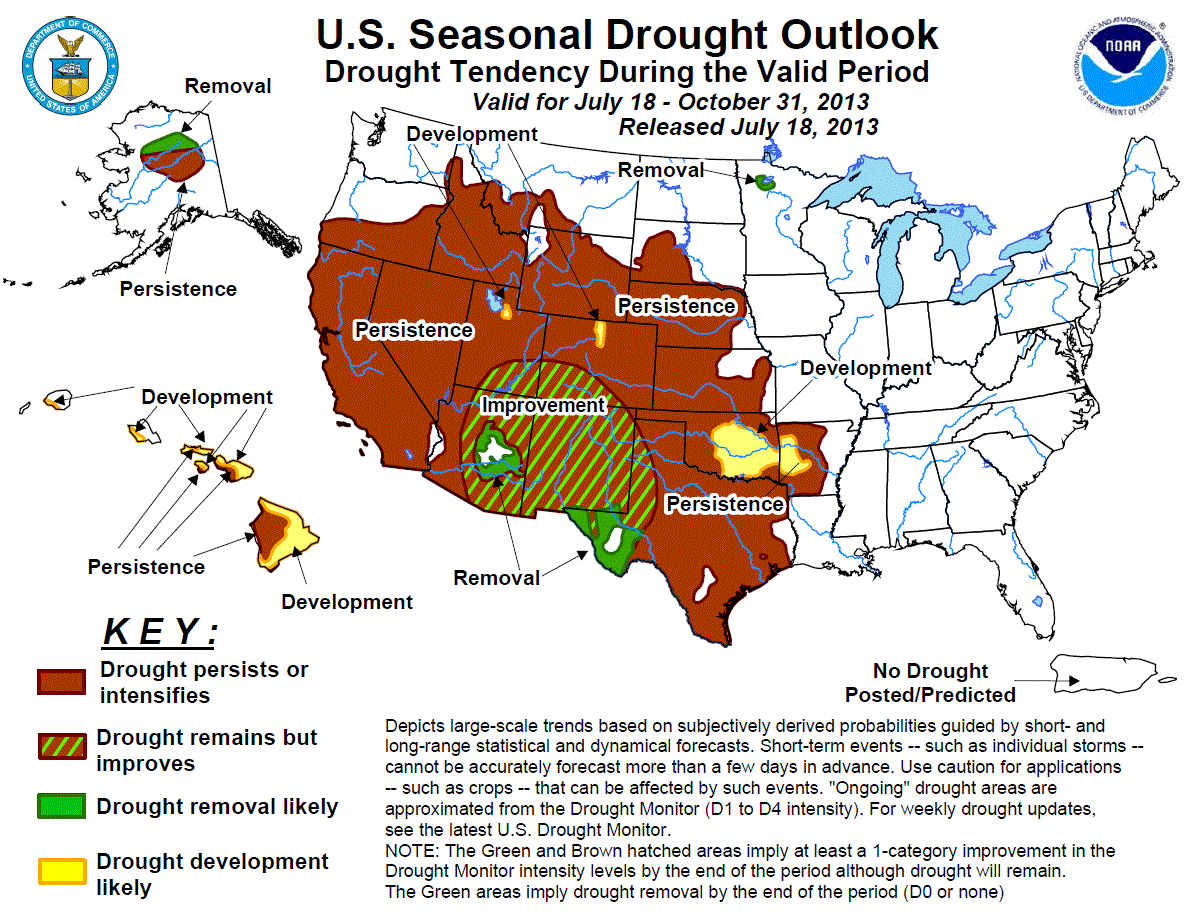
NOAA's latest seasonal drought outlook projects historic drought will persist.

By Lauren Morello and Andrew Freedman via Climate Central. See also the NY Times piece, “Thin Snowpack in West Signals Summer of Drought

Time is running out to avert a third summer of drought in much of the High Plains, West and Southwest, federal officials warned Thursday.

Without repeated, significant bouts of heavy snow and rain in the remaining days of winter, a large part of the country will face serious water supply shortages this spring and summer, when temperatures are hotter and average precipitation is normally low.

The drought already ranks as the worst, in terms of severity and geographic extent, since the 1950s. Though it’s not over yet, its economic impact appears to be severe, said Brad Rippey, a meteorologist at the Agriculture Department’s Office of the Chief Economist.

It “will probably end up being a top-five disaster event” on the government’s ranking of the costliest weather events of the past three decades, he said at a Capitol Hill briefing Thursday.

There is little relief predicted in the National Oceanic and Atmospheric Administration’s (NOAA) latest three-month drought outlook, which the agency released Thursday. Federal forecasters predict that drought will persist in the Rocky Mountain and Plains states, expand throughout northern and southern California and return to most of Texas, a state that has been mired in drought since 2011.

NOAA does forecast improvements in drought conditions in the Upper Midwest and Southeast, areas that have received beneficial precipitation in recent weeks.

“The next couple of months will kind of determine how the spring and summer plays out in that part of the country,” said Jake Crouch, a climate scientist at NOAA’s National Climatic Data Center in Asheville, N.C. Crouch said that continued drought conditions could threaten water supplies in many areas, particularly in the Southwest.

Dwindling Water Supplies

With drought extending into its second or even third year in some areas, the main concerns are shifting from agriculture and recreation to water supplies as rivers run dry and reservoirs shrink.

Speaking at the annual meeting of the American Association for the Advancement of Science in Boston on Feb. 15, Texas state climatologist John Nielsen-Gammon said water managers are especially concerned about the situation in West Texas, where emergency conservation plans have gone into effect as water supplies dwindle.

In the western U.S., low mountain snowpack is once again a concern, especially in portions of Colorado, New Mexico and Wyoming that feed the Platte and Arkansas rivers, said Mike Strobel of USDA’s National Resources Conservation Service.

Western mountain snowpack compared to average. (Credit: USDA)

“We’ve got the same trend we had last year,” Strobel said. “But prior to last year, we had very good snowpack, so there was a lot of moisture in reservoirs and soil” when drought conditions hit. This year, reservoirs are running low and soils are dry, which could magnify the impact of a winter without much snow buildup.

In Colorado, where 100 percent of the state is experiencing some level of drought, snowpack is at 70 percent of the long-term average and just 91 percent of last year’s total, Strobel said. Streamflow forecasts are poor and reservoir levels are low.

“We just don’t have the water in storage right now as we’re heading into the spring and summer, periods that are essential for agriculture and water management,” he said.

Those dry conditions and poor snowpack have also raised the risk that water levels could drop on the Mississippi River later this year, in a repeat of factors that reduced barge traffic last fall.

“We need rain in spring and fall so that we don’t have a crisis like we had this year on the Mississippi,” said Steve Buan from NOAA’s North Central River Forecast Center.

The portions of Minnesota, Wisconsin and Iowa that funnel water into the Mississippi are “bone dry,” Buan said. NOAA estimates there is a 40 percent chance that come fall of 2013, the Mississippi River will dip as low, or lower, than during the record-breaking autumn last year.

The drought was most likely initially set into motion by the cooler-than-average water temperatures in the tropical Pacific Ocean, combined with the effects of warmer-than-average waters in the Atlantic Ocean. Studies have shown that this combination tends to favor major drought events in the U.S.

But some scientists, such as Nielsen-Gammon, suggest that the overall warmer climate created by manmade global warming may have amplified this already devastating drought, particularly by triggering more intense heat during the spring and summer of 2012.

A recently released draft of a new federal climate change assessment shows that as the climate continues to warm in the next few decades, drought events are likely to become more frequent and severe, leading to more significant water supply and agricultural impacts in much of the U.S

Escalating Costs

The continuing drought has already taken a toll on the nation’s farmers, said the USDA’s Rippey.

Drought during last year’s growing season took “major hits on row crops,” especially corn and sorghum, he said. Parched conditions reduced the nation’s production potential for those two crops by about one-quarter. Drought cut corn yields by 4 billion bushels and sorghum yields by 100 million bushels.

According to Climate Central research released on Feb. 18, the states of Missouri, Illinois and Indiana were among the hardest hit “Corn Belt” states, with yields at nearly 30-year lows.

The U.S. soybean crop rebounded slightly during a cooler, wetter August last year, though the overall yield still dropped by 200 million bushels, USDA found.

But heading into spring, it’s winter wheat that is the most immediate concern, Rippey said. In Oklahoma and South Dakota, roughly two-thirds of the current winter wheat crop is rated “poor” or “very poor,” while more than half of Texas’ crop falls into the same categories despite some rainfall this winter.

“We are at high risk for abandonment this year,” Rippey said, predicting that farmers could walk away from 25 percent or more of the nation’s winter wheat this year, the worst since 2002, unless their crops begin receiving steady, regular rains.

USDA won’t release its official estimates of crop production for 2013 until mid-May. But the agency is optimistic that U.S. corn will do well this year, yielding 163.5 bushels per acre. July weather will tell the tale, Rippey said, but encouraging signs include ebbing drought in the eastern half of the Corn Belt.

Another Destructive Wildfire Season Ahead?

It’s still too early to tell whether poor snowpack and persistent drought will yield another severe fire season in the western U.S., experts said.

Last year’s fires consumed many of the dead and damaged trees and underbrush that fuel wildfires, said Jim Douglas, a senior advisor at the Interior Department.

“If that fuel doesn’t regrow, it’s not there,” he said. “So we could have drought conditions with nothing to burn yet. And we could have a spring with early moisture, with a lot of grass growing good and tall. If it dries out in late summer, we could have very bad fire conditions.”

The National Interagency Fire Center projects an immediate above-average fire risk in regions hardest hit by drought in its Feb. 1 outlook, including portions of the Oklahoma Panhandle and eastern Colorado. But in the drought-stricken Rocky Mountains and Southwest, fire season normally doesn’t begin until April, the center said, and what it will look like isn’t yet clear.

– By Lauren Morello and Andrew Freedman

jQuery(document).ready(function(){jQuery('#comment_submit').click(function(){if(jQuery('#comment_check:checked').length

View the original article here