
Sorry, I could not read the content fromt this page.
Showing posts with label Historic. Show all posts
Showing posts with label Historic. Show all posts
Monday, July 15, 2013

Sunday, May 26, 2013
Paul Ryan Learns Nothing from Historic Gender Gap: Budget Guts Women’s Health Programs
Our guest blogger is Lindsay Rosenthal, a Research Assistant for Health Policy and Women’s Health and Rights at the Center for American Progress.
 The 20 point gender gap in the 2012 election was the largest since Gallup poll began tracking in 1952 — the Obama-Biden ticket beat the Romney-Ryan ticket by a large margin with women, driven largely by women of color turning out at high rates for the President.
That loss was predictable based on polling that asked women questions about specific proposals in Paul Ryan’s previous budgets, which showed that women highly disapprove of cutting Medicaid, Medicare, and other vital programs that meet their health care needs. But the budget Ryan released this week suggests he learned nothing from women’s responses at the voting booth.
Ryan has never been a friend to women’s health, and has repeatedly taken action to limit women’s rights and access to health care — and his new budget is just more of the same. It would dismantle the advancements made through the Affordable Care Act and institute dramatic reductions in the services available through key programs, on top of the cuts women’s health services are already facing as a result of the sequester.
Here are the top four ways the new Ryan Budget (which is just the same as the old Ryan budget) guts key programs for women’s health:
Millions of women would lose the consumer protections and access to affordable health coverage that they gained under the health law. These reforms are critical for both women’s health and economic security.
The Ryan budget would eliminate the ban on discrimination against those with preexisting conditions, including breast cancer, Cesarean sections, rape, and health needs related to domestic violence; provisions that allow young women to stay on their parents health insurance plans until age 26; premium tax credits that help individuals and small businesses purchase health insurance; Obamacare’s expansion of Medicaid; and a slew of other benefits that the law provides for women’s health.
By repealing protections in Obamacare, the Ryan budget would preserve an individual health insurance market that routinely discriminates against women. Insurance companies in the individual market charge women $1 billion more in premiums than men each year for the same set of benefits. Under the health reform law, insurers will also be required to cover maternity care — only 12 percent of plans on the individual market currently do.
Women are 70 percent of adult Medicaid beneficiaries. In fact, more than one in ten non-elderly women receive their health insurance coverage through Medicaid.
But the Ryan budget would replace guaranteed federal funding for Medicaid with block grants to states — fixed sums of money set in advance, regardless of actual costs. By 2023, the Ryan budget would reduce federal Medicaid spending by 810 billion, forcing states to cut back on coverage and benefits. And by repealing Obamacare’s Medicaid expansion, the Ryan budget would deny Medicaid coverage to at least 7 million women who are expected to become newly eligible for the program if the law is fully implemented, leaving them with nowhere to turn for coverage.
Women represent over half of Medicare beneficiaries and 62 percent of those over the age of 80.
The Ryan budget would move toward a privatization of Medicare, proposing that those currently in the health program get vouchers for private insurance. Under the Ryan plan, the first seniors hit by these changes could pay up to $59,500 more during retirement, with those who will be Medicare eligible in 2050 paying up to $331,200 more.
Women on Medicare generally earn less in social security benefits than their male counterparts and have higher out-of pocket-medical costs. Paul Ryan’s plan to privatize Medicare threatens both the health and economic security of elderly women.
By repealing Obamacare and gutting Medicaid, the Ryan budget would severely undermine access to reproductive health care, especially contraception, for millions of women.
47 million women are projected to benefit from the no-cost preventive services that have already gone into effect, including mammograms, Pap smears, well-baby care, contraception, preconception and prenatal care in well-woman visits, gestational diabetes screening, lactation supports, and much more. In addition, the Medicaid program provides 75 percent of public funding for family-planning services and is expected to play an even greater role in providing access to family planning once the ACA is fully implemented.
Women of reproductive age spend 68 percent more on their health care expenses than men and their reproductive health care and the expense of birth control is a significant part of that spending. Surveys show that nearly one in four women with household incomes of less than $75,000 have put off a doctor’s visit for birth control to save money. More than half of young adult women say they have not used their prescribed contraceptive method as directed because it was cost-prohibitive.
Monday, April 29, 2013
Dust Bowl Days: Historic U.S. Drought Projected To Persist For Months, Worsened By Thin Western Snowpack
\ABS\Auto Blog Samurai\data\Obama Care\thinkprogress\2_21_13_news_andrew_droughtoutlook-e1361564246638.gif "2_21_13_news_andrew_droughtoutlook") NOAA's latest seasonal drought outlook projects historic drought will persist.
NOAA's latest seasonal drought outlook projects historic drought will persist.By Lauren Morello and Andrew Freedman via Climate Central. See also the NY Times piece, “Thin Snowpack in West Signals Summer of Drought”
Time is running out to avert a third summer of drought in much of the High Plains, West and Southwest, federal officials warned Thursday.
Without repeated, significant bouts of heavy snow and rain in the remaining days of winter, a large part of the country will face serious water supply shortages this spring and summer, when temperatures are hotter and average precipitation is normally low.
The drought already ranks as the worst, in terms of severity and geographic extent, since the 1950s. Though it’s not over yet, its economic impact appears to be severe, said Brad Rippey, a meteorologist at the Agriculture Department’s Office of the Chief Economist.
It “will probably end up being a top-five disaster event” on the government’s ranking of the costliest weather events of the past three decades, he said at a Capitol Hill briefing Thursday.
There is little relief predicted in the National Oceanic and Atmospheric Administration’s (NOAA) latest three-month drought outlook, which the agency released Thursday. Federal forecasters predict that drought will persist in the Rocky Mountain and Plains states, expand throughout northern and southern California and return to most of Texas, a state that has been mired in drought since 2011.
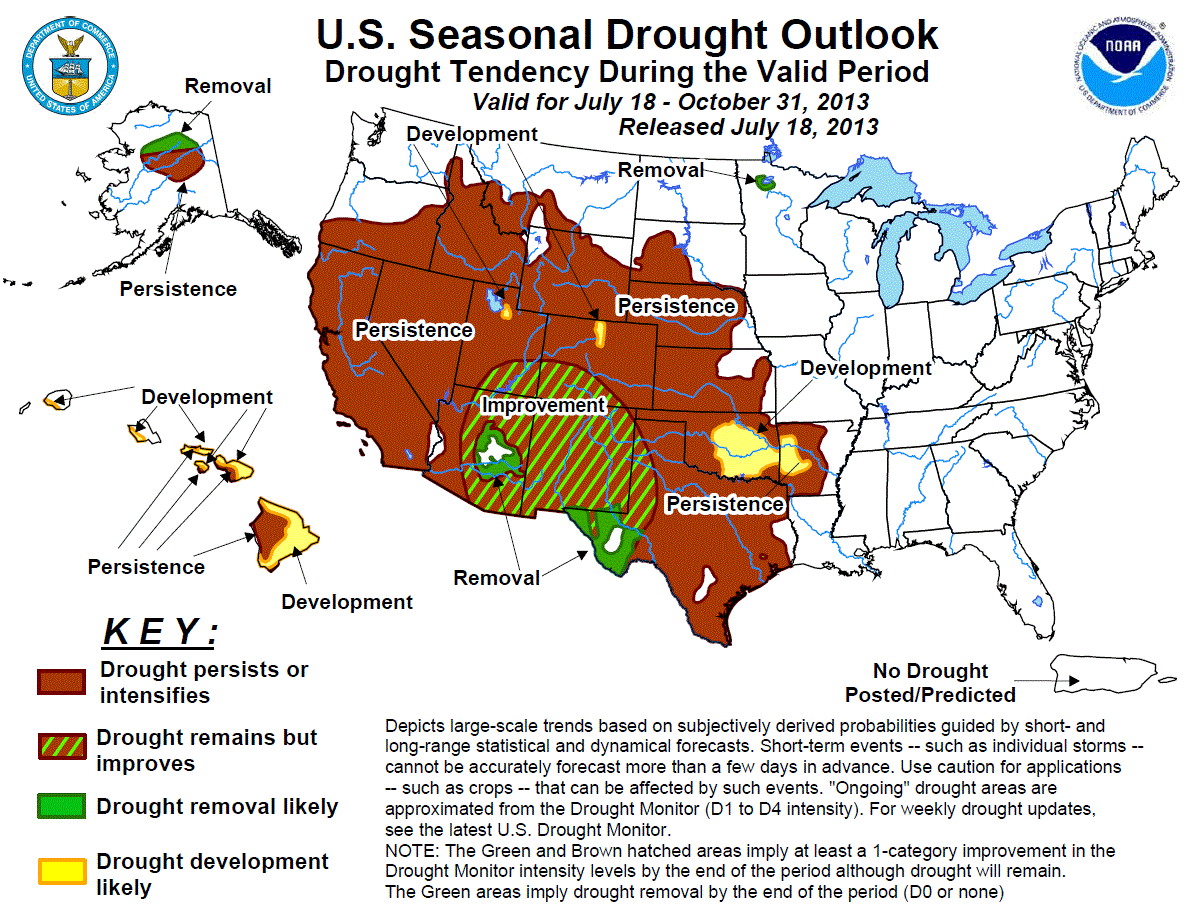
NOAA does forecast improvements in drought conditions in the Upper Midwest and Southeast, areas that have received beneficial precipitation in recent weeks.
“The next couple of months will kind of determine how the spring and summer plays out in that part of the country,” said Jake Crouch, a climate scientist at NOAA’s National Climatic Data Center in Asheville, N.C. Crouch said that continued drought conditions could threaten water supplies in many areas, particularly in the Southwest.
Dwindling Water Supplies
With drought extending into its second or even third year in some areas, the main concerns are shifting from agriculture and recreation to water supplies as rivers run dry and reservoirs shrink.
Speaking at the annual meeting of the American Association for the Advancement of Science in Boston on Feb. 15, Texas state climatologist John Nielsen-Gammon said water managers are especially concerned about the situation in West Texas, where emergency conservation plans have gone into effect as water supplies dwindle.
In the western U.S., low mountain snowpack is once again a concern, especially in portions of Colorado, New Mexico and Wyoming that feed the Platte and Arkansas rivers, said Mike Strobel of USDA’s National Resources Conservation Service.

\ABS\Auto Blog Samurai\data\Obama Care\thinkprogress\2_21_13_news_andrew_snowpack_2-e1361564181566.gif "2_21_13_news_andrew_snowpack_2") Western mountain snowpack compared to average. (Credit: USDA)
Western mountain snowpack compared to average. (Credit: USDA)“We’ve got the same trend we had last year,” Strobel said. “But prior to last year, we had very good snowpack, so there was a lot of moisture in reservoirs and soil” when drought conditions hit. This year, reservoirs are running low and soils are dry, which could magnify the impact of a winter without much snow buildup.
In Colorado, where 100 percent of the state is experiencing some level of drought, snowpack is at 70 percent of the long-term average and just 91 percent of last year’s total, Strobel said. Streamflow forecasts are poor and reservoir levels are low.

“We just don’t have the water in storage right now as we’re heading into the spring and summer, periods that are essential for agriculture and water management,” he said.
Those dry conditions and poor snowpack have also raised the risk that water levels could drop on the Mississippi River later this year, in a repeat of factors that reduced barge traffic last fall.
“We need rain in spring and fall so that we don’t have a crisis like we had this year on the Mississippi,” said Steve Buan from NOAA’s North Central River Forecast Center.
The portions of Minnesota, Wisconsin and Iowa that funnel water into the Mississippi are “bone dry,” Buan said. NOAA estimates there is a 40 percent chance that come fall of 2013, the Mississippi River will dip as low, or lower, than during the record-breaking autumn last year.
The drought was most likely initially set into motion by the cooler-than-average water temperatures in the tropical Pacific Ocean, combined with the effects of warmer-than-average waters in the Atlantic Ocean. Studies have shown that this combination tends to favor major drought events in the U.S.
But some scientists, such as Nielsen-Gammon, suggest that the overall warmer climate created by manmade global warming may have amplified this already devastating drought, particularly by triggering more intense heat during the spring and summer of 2012.
A recently released draft of a new federal climate change assessment shows that as the climate continues to warm in the next few decades, drought events are likely to become more frequent and severe, leading to more significant water supply and agricultural impacts in much of the U.S
Escalating Costs
The continuing drought has already taken a toll on the nation’s farmers, said the USDA’s Rippey.
Drought during last year’s growing season took “major hits on row crops,” especially corn and sorghum, he said. Parched conditions reduced the nation’s production potential for those two crops by about one-quarter. Drought cut corn yields by 4 billion bushels and sorghum yields by 100 million bushels.
According to Climate Central research released on Feb. 18, the states of Missouri, Illinois and Indiana were among the hardest hit “Corn Belt” states, with yields at nearly 30-year lows.
The U.S. soybean crop rebounded slightly during a cooler, wetter August last year, though the overall yield still dropped by 200 million bushels, USDA found.
But heading into spring, it’s winter wheat that is the most immediate concern, Rippey said. In Oklahoma and South Dakota, roughly two-thirds of the current winter wheat crop is rated “poor” or “very poor,” while more than half of Texas’ crop falls into the same categories despite some rainfall this winter.
“We are at high risk for abandonment this year,” Rippey said, predicting that farmers could walk away from 25 percent or more of the nation’s winter wheat this year, the worst since 2002, unless their crops begin receiving steady, regular rains.
USDA won’t release its official estimates of crop production for 2013 until mid-May. But the agency is optimistic that U.S. corn will do well this year, yielding 163.5 bushels per acre. July weather will tell the tale, Rippey said, but encouraging signs include ebbing drought in the eastern half of the Corn Belt.
Another Destructive Wildfire Season Ahead?
It’s still too early to tell whether poor snowpack and persistent drought will yield another severe fire season in the western U.S., experts said.
Last year’s fires consumed many of the dead and damaged trees and underbrush that fuel wildfires, said Jim Douglas, a senior advisor at the Interior Department.
“If that fuel doesn’t regrow, it’s not there,” he said. “So we could have drought conditions with nothing to burn yet. And we could have a spring with early moisture, with a lot of grass growing good and tall. If it dries out in late summer, we could have very bad fire conditions.”
The National Interagency Fire Center projects an immediate above-average fire risk in regions hardest hit by drought in its Feb. 1 outlook, including portions of the Oklahoma Panhandle and eastern Colorado. But in the drought-stricken Rocky Mountains and Southwest, fire season normally doesn’t begin until April, the center said, and what it will look like isn’t yet clear.
– By Lauren Morello and Andrew Freedman
jQuery(document).ready(function(){jQuery('#comment_submit').click(function(){if(jQuery('#comment_check:checked').lengthSunday, March 24, 2013
Historic Blizzard Poised to Strike New England: What Role Is Climate Change Playing?
\ABS\Auto Blog Samurai\data\Obama Care\thinkprogress\Nemo.jpg "Nemo")
An epic blizzard is bearing down on New England — fed in part by relatively warm coastal waters.
I asked Dr. Kevin Trenberth, former head of the Climate Analysis Section at the National Center for Atmospheric Research, to comment on the role climate change has on this storm. He explained:
This is a perfect set up for a big storm, with the combination of two parts: a disturbance from the Gulf region with lots of moisture and a cold front from the west.Ingredients for a big snow storm include temperatures just below freezing. In the past temperatures at this time of year would have been a lot below freezing but the ability to hold moisture in the atmosphere goes down by 7% per degree C (4% per deg F), and so in the past we would have had a snow storm but not these amounts.The moisture flow into the storm is also important and that is enhanced by higher than normal sea surface temperatures (SSTs). These are higher by about 1 deg C [almost 2°F] than a normal (pre-1980) due to global warming and so that adds about 10% to the potential for a big snow.Every storm and “event” is unique. It always has unique ingredients. So it is hard if not impossible to take apart, because any piece missing means the storm behaves differently. So event attribution is not well posed. Instead we look for the environment in which the storm is occurring and how that has changed to make conditions warmer and moister over the oceans.
Like a baseball player on steroids, our climate system is breaking records at an unnatural pace. And like a baseball player on steroids, it’s the wrong question to ask whether a given home run is “caused” by steroids. As Trenberth wrote in his must-read analaysis, “How To Relate Climate Extremes to Climate Change,” the “answer to the oft-asked question of whether an event is caused by climate change is that it is the wrong question. All weather events are affected by climate change because the environment in which they occur is warmer and moister than it used to be.”
On the warmer SSTs, Climate Central’s Andrew Freedman explains:
As was the case when Hurricane Sandy struck in late October, sea-surface temperatures are running a couple degrees above average off the East Coast, which according to climate scientists may reflect both natural climate variability and the effects of manmade global warming.
The presence of unusually warm waters could aid in the rapid development of the storm system, and infuse it with additional moisture, thereby increasing snowfall totals.
Heavy precipitation events in the Northeast, including both rain and snowstorms, have been increasing in the past few decades, in a trend that a new federal climate report links to manmade global climate change. As the world has warmed, more moisture has been added to the atmosphere, giving storms additional energy to work with, and makingprecipitation extremes more common in many places.
\ABS\Auto Blog Samurai\data\Obama Care\thinkprogress\Nemo2.jpg "Nemo2")
Sea surface temperature anomalies off the East Coast. Credit Wunderground/NOAA via CC.
The blizzard is also pulling in an extraordinary amount of moisture, which is consistent with recent trends in the Northeast toward more frequent one-day precipitation extremes during the cold season, including snowstorms. The satellite-derived image of total precipitable water shows that the storm has been drawing tropical moisture from the Pacific Ocean, Gulf of Mexico, and the Atlantic Ocean
Trenberth’s second point is an important one — warmer than normal winters favor snow storms (See “We get more snow storms in warm years“). A 2006 study, “Temporal and Spatial Characteristics of Snowstorms in the Contiguous United States“ found we are seeing more northern snow storms and that we get more snow storms in warmer years:
The temporal distribution of snowstorms exhibited wide fluctuations during 1901-2000…. Upward trends occurred in the upper Midwest, East, and Northeast, and the national trend for 1901-2000 was upward, corresponding to trends in strong cyclonic activity….
Assessment of the January-February temperature conditions again showed that most of the United States had 71%-80% of their snowstorms in warmer-than-normal years…. a future with wetter and warmer winters, which is one outcome expected (National Assessment Synthesis Team 2001), will bring more snowstorms than in 1901-2000. Agee (1991) found that long-term warming trends in the United States were associated with increasing cyclonic activity in North America, further indicating that a warmer future climate will generate more winter storms.
The U.S. Global Change Research Program (USGCRP) U.S. Climate Impacts Report from 2009 reviewed that literature and concluded, “Cold-season storm tracks are shifting northward and the strongest storms are likely to become stronger and more frequent.
So it is no surprise that a 2012 study found extreme snowstorms and deluges are becoming more frequent and more severe. Freedman points out:
For the northern hemisphere as a whole, winter storms have become more common and intense during the past 50 years, according to the draft federal report. Observed changes in winter air circulation in the northern hemisphere, possibly related to Arctic sea ice loss, has been linked to large swings in seasonal snowfall from one winter to the next in the Northeast. Other studies indicate that as global warming continues, nor’easters such as the one about to hit New England may become more frequent in this region, and less common in the Mid-Atlantic states, as storm tracks shift closer to the poles.
Again, the Northeast has been especially vulnerable to deluges and Snowmaggedons, experiencing a sharp increase in one-day precipitation extremes during the October to March cold season:
\ABS\Auto Blog Samurai\data\Obama Care\thinkprogress\CEI.gif "CEI")
The other big impact of global warming on the destructiveness of superstorms like this (and Sandy) is sea level rise:
The coastal flooding threat for this storm in New York pales in comparison to what it was during Hurricane Sandy, when large parts of the city’s iconic subway system flooded in the face of a record storm surge, and many New Yorkers drowned in flood waters.
Rising sea levels due to warming seas and melting ice caps are already making typical nor’easters such as the upcoming event more damaging, since they provide the storms with a higher launching pad for causing coastal flooding. According to the draft National Climate Assessment report released in January, even without any changes in storms, the chance of what is now a 1-in-10-year coastal flood event in the Northeast could triple by 2100, occurring once every 3 years, due to rising sea levels.
According to research by Climate Central scientists, the sea level trend in Boston Harbor from 1959 to 2008 in Boston Harbor has been 2.31 milimeters per year, which is slightly below the global average over the same period. In the past 50 years, the water level has risen by about 4.5 inches at that location, although it has increased much more in other spots along the northeastern coast.
On Nantucket Island, where coastal flooding is anticipated from this storm along with hurricane-force winds, the sea level has risen by about half a foot during the past 50 years.
People should take the weather forecasts of this storm seriously and act accordingly.
Similarly, the nation should take seriously the climatic projections of ever worsening storms from global warming — and act accordingly.
jQuery(document).ready(function(){jQuery('#comment_submit').click(function(){if(jQuery('#comment_check:checked').lengthThursday, February 28, 2013
Three Charts Reminding The GOP That Domestic Spending Is Already Headed Toward Historic Lows
 Republicans like to portray President Obama as a big government spender, despite the fact that government spending under Obama has grown at its slowest pace since the Eisenhower administration. The GOP is also trying to pretend the spending cuts that Obama has signed into law over the last two years simply didn’t happen.
In fact, under its current trajectory, non-defense discretionary spending — everything from education to food safety to transportation to housing to veterans’ benefits — will hit historic lows in the next decade, as Center for American Progress Director of Tax and Budget Policy Michael Linden showed in these charts:


If the so-called “sequester” comes into force in March, which House Budget Committee Chairman Paul Ryan (R-WI) says it will, domestic spending will fall even more. “Instead of totaling 3.2 percent of GDP in 2017, nondefense discretionary spending would total less than 3 percent of GDP and would be on its way down to 2.6 percent by 2022. This is less than two-thirds of what was previously its lowest level,” Linden wrote.
Wednesday, February 20, 2013
Study: South American Glaciers In Historic Retreat
 One of the more dramatic effects of global warming is shrinking glaciers around the globe. 10 to 20 percent of glacier ice in the European Alps, for example, has been lost in less than two decades, and half the volume of the mountain range’s glacier ice has melted away since 1850.
Thinning and melting rates in Alaskan glaciers more than doubled over the last decade, African glaciers have declined by 60 to 70 percent since the 1900s, and most Pacific glaciers are also receding. Summer ice coverage in the Arctic could disappear entirely within a decade, and Glacier National Park may not have any glaciers by 2030.
This isn’t just destructive to wildlife and ecosystems. Given their locations, glaciers can serve as crucial supplies of fresh water for various human populations — and as they shrink year after year, those supplies tighten.
The latest example comes from a new report by The Cryosphere, which documents the shrinkage of glaciers in the Andes mountain range of South America. The glaciers have shrunk by at least a third, and possibly as much as half, since the 1970s alone. And the worst loss has been seen in the smaller, lower altitude glaciers which supply fresh water for many of the continent’s residents, according to a round-up of the report by Reuters:
Climate change has shrunk Andean glaciers between 30 and 50% since the 1970s and could melt many of them away altogether in coming years, according to a study published on Tuesday in the journal Cryosphere.
Andean glaciers, a vital source of fresh water for tens of millions of South Americans, are retreating at their fastest rates in more than 300 years, according to the most comprehensive review of Andean ice loss so far.
The study included data on about half of all Andean glaciers in South America, and blamed the ice loss on an average temperature rise of 0.7 degree Celsius over the past 70 years. [...]
The researchers also warned that future warming could totally wipe out the smaller glaciers found at lower altitudes that store and release fresh water for downstream communities.
\ABS\Auto Blog Samurai\data\Obama Care\thinkprogress\andean-glaciers-e1359062794900.jpg "andean glaciers")
The plot above tracks the changes in surface area for the various glaciers in the Andes since the Little Ice Age in the mid-17th to early-18th centuries. The measurements prior to 1940 were put together from studies of debris associated with the glaciers, and reconstructed from aerial photographs after that point. The drop-off in the second half of the 20th Century is precipitous.
The Zongo Glacier (the red squares) managed to avoid the dramatic shrinkage of the other glaciers because it sits at a higher altitude. The lower altitude glaciers are more vulnerable to temperature shifts, and thus have seen the worst of the melting. They’re also the glaciers that supply fresh water for both the agriculture and consumption of large populations in the arid regions of Peru and Bolivia, serving as a buffer for those communities during the dry season from May/June to August/September.
As the glaciers recede, that buffer shrinks, leaving those water supplies ever more strained. Meanwhile, the tendency of global warming to drive more extreme weather patterns could exacerbate the severity of the dry season, dealing a double blow to the people of Peru and Bolivia.
jQuery(document).ready(function(){jQuery('#comment_submit').click(function(){if(jQuery('#comment_check:checked').length
Subscribe to:
Posts (Atom)