Showing posts with label Another. Show all posts

Tuesday, June 25, 2013

How Fed Policy Could Leave The Country At The Mercy Of Another Recession

The Federal Reserve released its statement from the latest Federal Open Market Committee meeting this past week. Its projections see economic growth reaching 3.8 percent at best over the next three years, hovering between two and three percent per year after that, and finally driving unemployment down to between five and six percent after 2015.

None of that is especially new or encouraging. But on Wednesday, Ryan Avent at The Economist pointed out another number in the report that hints at a more subtle, but possibly more pernicious problem. It’s the federal funds rate, which is the interest rate the Fed charges other banks when it lends them money — thereby guiding interest rates throughout the economy — and which has basically been at zero since the Great Recession:

If recovery proceeds as the Fed anticipates, its interest-rate target will remain at near zero until at least 2015. Perhaps more worrying, the FOMC’s best guess at the appropriate, long-run value of the fed funds rate is about 4 percent. That is strikingly low. In each of the past three recessions the Fed has responded by cutting the fed funds rate more than 4 percentage points. A fed funds rate at that level virtually guarantees that the next downturn will result in a relapse into [zero lower bound] territory.

The Fed has a dual mandate to control inflation and maximize employment, and the federal funds rate is the mechanism by which it does both. It can boost the economy by cutting the rate, or rein in inflation by raising the rate. So there’s an inherent balancing act, and the Fed needs room to go in both directions. That’s why, over the past 40 years, the rate only briefly dipped below the four percent mark, and spent most of the boom-time 90s at over five percent:

There’s an imbalance in the Fed’s policy toolkit, in that it can raise the rate as high as it wants to fight inflation, but it can’t cut it past zero to boost the economy and job growth. That’s the problem of the “zero lower bound” Avent refers to. If the rate doesn’t get above four percent, but the Fed needs to cut at least that much to boost the economy, then there’s just not going to be much room to maneuver when the next recession rolls around.

Some economists such as Paul Krugman argue that when monetary policy hits the zero lower bound, fiscal policy (i.e. stimulus spending) becomes the primary tool to help the economy. But others, like Scott Sumner, argue that quantitative easing and other forms of unconventional monetary policy can still work just as well if not better than fiscal policy when the federal funds rate is at zero.

Unfortunately, Republicans are vociferously opposed to both policies. They’ve relentlessly pressured the Fed and Chairman Ben Bernanke to end quantitative easing or even hike the federal funds rate, incessantly warning of runaway inflation that never materializes. There’s also been no real opposing pressure from Democrats or progressives to prioritize job growth. The Fed’s latest form of quantitative easing has been a big step in the right direction, but several members of the governing committee or so skittish they’ve proposed ending it as early as this year.

On top of that, the way the Fed is designed and governed saddles it with additional biases towards cutting inflation over pushing up employment. As an institution, it’s more attuned to the concerns of the financial industry, business owners and the wealthy. Those groups are generally indifferent to sluggish economic growth — they’re the last to lose their homes or livelihoods if the economy implodes or unemployment spikes — but they all have a vested interest in low and stable inflation.

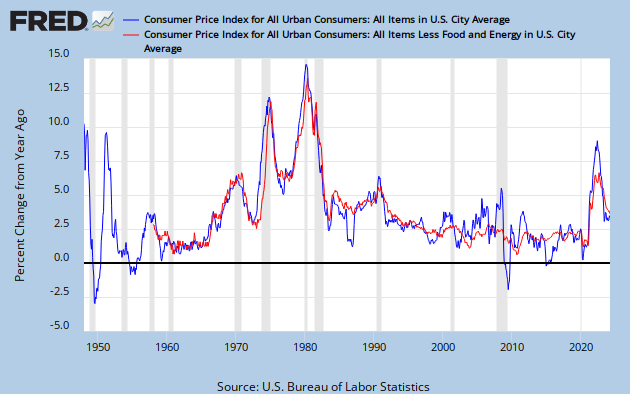
So not surprisingly, for the last twenty years or more, low and stable inflation is exactly what the country got. Even after the Great Recession, the Fed consistently hit its two percent inflation target, even as its counterbalancing mandate to boost employment was essentially ignored:

Arguably, the fundamental problem is the Fed did too good a job at reining in inflation.

Inflation is the natural response of an economy to robust growth, as rising wages put upward pressure on other prices. A Fed devoted to controlling inflation above all else will inevitably also weigh down jobs and wages for working Americans. “Morning in America,” the economic boom of the Reagan years, was accompanied by four percent inflation on average — twice the level we’re seeing now.

The last few decades of low inflation also came alongside stagnating median wages, and a new form of “jobless” recovery that brings back economic growth, but not the job growth of previous post-war recoveries. The result has been a self-reinforcing downward spiral, as stalled wages bring more inequality and less inflation, eliminating the need for a higher federal funds rate and ultimately leaving the Fed with ever less ammunition to boost employment with each successive recession.

Certainly, the Fed’s preference for exceedingly low inflation is not the whole cause behind slow wage growth and rampant inequality. But it’s most likely a big part.


View the original article here

Tuesday, June 18, 2013

Another Football Player Accused Of Rape, Another Community Blaming The Victim

Two football player high school students in Connecticut are charged with the second-degree sexual assault of a 13-year-old girl. The allegations come amid other complaints of hazing at the school, but Torrington High School officials insist that these are individual instances and not a part of a larger cultural problem.

But whether or not the alleged rapists Edgar Gonzalez and Joan Toribio, both 18, are maverick sexual assailants isn’t really the cultural question. Rather, the fact that students in the neighborhood and the school have taken to Twitter blame the young girl and not the alleged rapists highlights a broader rape culture that assumes men are only haphazardly involved in sexual assault, but it is usually the victim’s fault:

“If you look at crime statistics these things happen everywhere and we’re not any different than any other community,” said [Athletic Director Mike McKenna].

But on social media in recent weeks, dozens of athletes and Torrington High School students, male and female, have taunted the 13-year-old victim, calling her a “whore,” criticizing her for “snitching” and “ruining the lives” of the 18-year-old football players, and bullying students who defend her.

The Connecticut Register-Citizen highlights some of the offensive tweets about the girl:

I wanna know why there’s no punishment for young hoes,” asked “@asmedick.” That comment was reposted three times.

Twelve days after the alleged incident, “@AyooWilliam” tweeted, “You destroyed two people’s life.” Another responded, “I hope you got what you wanted.”

“Sticking up for a girl who wanted the D and then snitched? have a seat pleaseeee,” wrote “@ShelbyyKalinski.”

As the case in Steubenville proved, social media has brought a whole new slew of evidence to sexual assault allegations, particularly among young people. Unfortunately, the lesson some news outlets take from this is that Steubenville was “a cautionary tale for teenagers living in today’s digital world.” In reality, social media helps to underline a very real problem: A victim-blaming rape culture that is inclined to take the side of the assailant instead of the victim.

(HT: Raw Story)


View the original article here

Monday, May 20, 2013

Afghan President Lodges Another Ridiculous Claim Against U.S. Troops

Afghan President Hamid Karzai

Afghan President Hamid Karzai, never one to mince words, on Sunday told the press that the United States and Taliban were each colluding to keep foreign troops in Afghanistan, albeit for different reasons.

Several explosions ripped through Afghanistan over the weekend during U.S. Secretary of Defense Chuck Hagel’s visit, killing 19 civilians and highlighting security concerns that continue apace ahead of a U.S. withdrawal from Afghanistan in 2014.

According to Karzai, the attacks by the Taliban were meant to show that international forces will still be required after the 2014 deadline passes. Karzai chose a curious time to air his theory, putting it forward while delivering a speech on Afghan women:

“The explosions in Kabul and Khost yesterday showed that they are at the service of America and at the service of this phrase: 2014. They are trying to frighten us into thinking that if the foreigners are not in Afghanistan, we would be facing these sorts of incidents” he said.

Defense Department officials quickly cancelled a planned joint press conference after Karzai’s statements, denying the cancellation had anything to do with Karzai’s statements. The head of the International Security Assistance Force (ISAF) — the coalition headed by the U.S. in Afghanistan — strongly denounced the idea that the U.S. would work with the Taliban to keep U.S. forces in the country. “We have fought too hard over the past 12 years. We have shed too much blood over the past 12 years. We have done too much to help the Afghan Security Forces grow over the last 12 years to ever think that violence or instability would be to our advantage,” said Marine Gen. Joseph Dunford.

Karzai has a lengthy history of inflammatory statements, usually intended to provide himself some form of leverage when dealing with his Western counter-parts or bolster himself domestically. In 2010, Karzai threatened to join Taliban after coming under pressure to launch reforms in the Afghan government. Karzai also warned against the continuation of NATO airstrikes in 2011, saying that NATO risked becoming an occupying force, adding that “history shows what Afghans do with trespassers and with occupiers.”

Tensions between the U.S. and Afghans stretch beyond difficulties in relations with Karzai. Reports on Monday say an Afghan police officer opened fire killing two U.S. troops and three of his fellow officers. These “green on blue” attacks — in which Afghan allies turn on their Western counterparts — have proved to be an ongoing impediment to lasting trust between U.S. and Afghan forces. Gen. John Allen, then the U.S. commander in Afghanistan, told 60 Minutes that coalition troops were willing to sacrifice for the Afghan campaign, but unwilling to be murdered.


View the original article here

Wednesday, March 6, 2013

UPDATE 1-Second Twitter hoax in two days smacks another stock

(Adds details, comments from traders, recasts lead)

NEW YORK, Jan 30 (Reuters) - Sarepta Therapeutics Inc became the second company in as many days see its shares plunge as a result of a Twitter hoax on Wednesday after a user posed as an influential short-seller and alleged improprieties at the biopharmaceutical company.

Sarepta Therapeutics shares plummeted 9.9 percent in a matter of seconds after someone with the Twitter user name zcitreonresearc alleged improprieties at the company.

The drop mirrored a similar incident on Tuesday, when Audience Inc fell more than 25 percent following tweets that at a glance looked to be from Muddy Waters, another short-selling firm.

Just as Muddy Waters confirmed it did not send such a tweet about Audience, so too did Andrew Left, the California-based investor who runs Citron, said his company did not send a message about Sarepta.

The twin incidents targeted a pair of Nasdaq stocks that are not among the most actively traded on a daily basis, showing how certain company shares are vulnerable to information posted on social media networks, even if the information is misleading. Sarepta, on average, trades about 1.4 million shares a day; by contrast, average daily volume in chipmaker Intel Corp is about 52 million shares.

"You need a more volatile stock for this kind of manipulation - obviously if you were to try it on IBM it wouldn't work," said Joe Saluzzi, co-manager of trading at Themis Trading in Chatham, New Jersey. "It speaks to the structure of the market where shallow pools of liquidity can be easily pierced on bad news, even if the news is fake."

The U.S. Securities and Exchange Commission had no comment.

Twitter did not respond to an emailed request for comment on the messaging activity, but the zcitreonresearc account has been suspended. The Twitter account zMudd1waters, whose Twitter home page looks like Muddy Waters, was still active.

The tweet, with the user name "zcitreonresearc," alleged that drug trial results from the biopharmaceutical company had been tainted and doctored, according to screen shots of the posting captured by Twitter users. Sarepta was not immediately available for comments on the trading activity or the account, which has since been suspended.

Matt, a trader in San Diego who did not want to give his last name, but who goes by the handle zgiven2tweet on Twitter, said, "There's a real severity to that tweet. It's at the core of what the company is, is this one trial."

Sarepta shares recovered after the brief fall. It was trading up 1.4 percent to $27.56 on volume of about 3.5 million shares in afternoon trading. More than 700,000 shares traded in the one minute when the stock suffered its steep decline.

The company, which has a market cap of about $692 million, is volatile, moving more than 1 percent in six of the past seven sessions. It jumped 477 percent in 2012 alone.

Audience went public in May 2012 and has a market cap of $254 million as of Tuesday's closing price, rising about 15 percent so far this year. The stock's 50-day average daily volume is slightly more than 160,000 shares, but that rose to more than 800,000 on Tuesday.

"Not really an efficient market when fake twitter accounts can crash stocks," Tim McClure, equity trader at SMB Capital in New York, wrote on his Twitter page.

Shares of Audience were briefly halted on Tuesday, but Sarepta shares did not reach a threshold necessary to trigger a halt. A Nasdaq spokesperson was not available for comment.

(Additional reporting by Daniel Bases and Emily Flitter; Editing by David Gaffen and Leslie Gevirtz)


View the original article here

Friday, January 18, 2013

Largest U.S. Medical Marijuana Dispensary Beats Back Another Shutdown Attempt

Harborside Health Center founder Steve DeAngelo

Last month, a California judge rejected a landlord’s move to evict the nation’s largest medical marijuana dispensary for engaging in a business that is legal under state law. Now, a federal judge has also barred the landlord’s attempt to halt the dispensary’s operations.

In the ongoing federal-local battle over state laws that legalize medical marijuana, the court ruling is the latest victory for Harborside Health Center, a 100-plus-employee operation that Oakland City Attorney Barbara Parker has praised for providing “access to safe, affordable and effective medicine.” While the Obama administration initially said it would not target medical marijuana dispensaries in compliance with state law, it has since fluctuated on this position, and pursued increasingly vigorous crackdowns. To shut down Harborside, the federal government filed a civil action to seize the Oakland and San Jose, Calif. properties Harborside leases for its dispensaries. The owners of the two properties attempted to skirt the federal case by moving to evict Harborside or cease its marijuana distribution. One county judge rejected the move, while another has allowed eviction proceedings to move forward. But U.S. Magistrate Judge Maria-Elena James held Monday that the federal Controlled Substances act cannot be enforced by private parties like these landlords:

As Harborside points out, courts have consistently held that there is no private right of action under the CSA to force compliance. […]

Moreover, while the Court understands Claimants’ concern over the potential forfeiture of their properties, Rule G(7)(a) is not a means to sever business relationships when they suddenly prove risky or to demonstrate cooperation with the Government.

The landlords and the Department of Justice will now litigate between themselves over the move to seize the properties where Harborside is housed. The city of Oakland also filed an unprecedented, affirmative lawsuit to halt federal government crackdowns of medical marijuana dispensaries in the city. The city alleges that the federal government exceeded its authority with its civil forfeiture action by acting contrary to earlier statements and actions that indicated it would not crack down on those dispensaries in compliance with state medical marijuana laws, now in 18 states.

The litigation raises the question of how the federal government will handle Washington and Colorado’s new laws to legalize and regulate recreational marijuana. In the first comment on the measures, President Obama said recreational users are not a “high priority.” He did not, however, refer to marijuana sellers and suppliers, which would be the likely subjects of any federal crackdown.

In the wake of the crackdown, landlords have been unwilling to rent to several other dispensaries that were approved for operation in Oakland.


View the original article here

Sunday, May 20, 2012

Tech at Night: Pirate Bay DDoSed by copyright defenders? Net Neutrality continued. Issa takes on another treaty.

Tech at Night

Earlier we covered Microsoft’s new Pirate Pay, which I said sounded like a DoS attack against copyright infringers. Others agree and say it may be illegal, which is true. Sure enough, Pirate Bay is under DDoS attack. Has Pirate Pay gone rogue? Cybersecurity and copyright, all in one issue.

This week Less Government hosted a debate on tech issues in DC, and it got feisty at times. I found it fascinating though. Gigi Sohn and Andrew Schwartzman (Thomas Gideon was detained and missed much of the fun) on the left were constantly talking about how they don’t favor big government, they support only minimalist regulation to preserve a competitive, free market, and all that good stuff. They went to great lengths to sound centrist. I believe they also revealed a strategy of fighting one issue at a time, separately, whether the individual arguments conflict or not. This lets them advance the ball any way they can.

Seton Motley, Phil Kerpen, and Andrew Moylan were less conciliatory. They were aggressively vocal about a small government perspective, and in particular Kerpen was a beast on offense against Net Neutrality. This kind of passion and insistence on core principles may make it tougher to sever fights to build winning single-issue coalitions, but it keeps us consistent. I think we need to be mindful of the advantages and disadvantages of each approach. We could never build a coalition like Save the Internet, as the radicals did for Net Neutrality.

But Net Neutrality is still technically in effect, and will be unless and until the courts throw out the Open Internet order. As long as it’s there, it’s worth making strong arguments against it, such as Richard Bennett’s. It’s also worth noting that content-based services like Dish’s ad skipping could be considered non-neutral and illegal innovation if applied to the Internet.

Remember the ACTA treaty, negotiated in secret that threatened to be a global SOPA? Well, some appear to be say ing that the Trans-Pacific Partnership has similar provisions, or at least threatens to. So Darrell Issa is publishing key portions of the treaty for public scrutiny. Interesting.

Ron Wyden, like me and early opponent of SOPA and Protect IP, has come out against the Lieberman-Collins cybersecurity bill favored by the President. And, credit where it’s due: so has Al Franken, though both do so on privacy grounds, not power-grab grounds. But, referencing the above discussion of single-issue coalitions, I’m not going to complain, and instead will question whether a Democrat bill can pass when it’s losing both tech centrist Ron Wyden and reliable lefty Al Franken. Seriously: Obama has lost Franken on this issue. Wow.

On the Republican side, I sounded the alarm that Jon Kyl and Roy Blunt may be trying to form a Gang of Four to undermine the John McCain-led Republican team against Lieberman-Collins, and instead push a ‘compromise.’ That meeting has been put off to allow McCain and co. to attend and presumably to pitch the virtues of the SECURE IT alternative bill. I’m glad.

House Republicans question whether LightSquared was a victim of FCC’s troublesome, opaque practices as Chuck Grassley has moved on from LightSquared as his target to Google. This is remarkable. I remember when I’d make pro-LightSquared comments and get dogpiled by people insisting LS was the new Solyndra. Now, there seems to be a chance on this issue, to recognize how disappointing it is that LightSquared can’t add its technological distinctiveness to our own national 4G market, and raise the bar of competition.

I join these calls for spectrum to be freed up. Especially as FCC goes out of its way to destroy the secondary market for spectrum, in all its forms, we need a way for spectrum to be allocated to firms for faster, newer wireless technologies.

Google’s defeat in the Java/Android case goes to the damages phase, despite claims that Google didn’t really lose yet. I’m honestly shocked at how much defense Google gets even from the right, when nobody denies that Google lifted heavily from Java, and even hired former Java people to clone it for Android’s virtual machine technology.


View the original article here

Friday, April 27, 2012

Yet Another Reason Why Today’s Unions Suck: Dues Devour Wage Increases

On the eve of Obama’s NLRB unleashing its new rules giving unions the ability to hold ambush elections—that is, the evisceration of employers’ ability to question or challenge unions in their quest to cherry-pick voting units—more data was just released by the Bureau of National Affairs that calls into question why anyone in their right mind would pay dues to a union today.

In addition to the $369 billion in underfunded union (private-sector) pension plans, the abundant evidence that unions kill companies and destroy jobs, today’s unions are doing such a miserable job at the one thing they’re supposed to do—negotiate contracts—that union members should demand refunds from their union bosses.

According to the April 9th issue of the Bureau of National Affairs Daily Labor Report (subscription required), unions negotiated contracts in 2011 that, in 41% of the contracts, employees received no increase in the contract’s first year.

While 41% of the contracts negotiated by unions in 2011 contained wage freezes, according to BNA’s survey, of the contracts where increases were negotiated, the average wage increase that was obtained for the first year was a pathetic 1.4%.

According to BNA:

A Bloomberg BNA analysis of collective bargaining agreements negotiated in 2011 found that the average first-year wage increase under contracts negotiated last year was 1.4 percent, compared with 1.6 percent reported in 2010. The average second-year increase in 2011 was 1.7 percent, compared with 2 percent in 2010, and the average third-year increase was 2.1 percent, compared with 2.3 percent a year earlier….

Given that union dues for most union members range from around 1.3% to 5% of pay, once union dues are deducted from members’ wages, the negotiated increases unions “achieved” for their members in 2011 are eaten up (and then some) by union dues.

Of course, union bosses continue to blame “the 1%” for their failure to garner anything better for their union members.

However, the reality is, today’s unions have become nothing more than an albatross riding on the backs of job creators and their employees.

_____________

Originally posted on LaborUnionReport.com.

Follow LUR on Twitter.

“Truth isn’t mean. It’s truth.”
Andrew Breitbart (1969-2012)


View the original article here