Showing posts with label Recession. Show all posts

Tuesday, June 25, 2013

How Fed Policy Could Leave The Country At The Mercy Of Another Recession

The Federal Reserve released its statement from the latest Federal Open Market Committee meeting this past week. Its projections see economic growth reaching 3.8 percent at best over the next three years, hovering between two and three percent per year after that, and finally driving unemployment down to between five and six percent after 2015.

None of that is especially new or encouraging. But on Wednesday, Ryan Avent at The Economist pointed out another number in the report that hints at a more subtle, but possibly more pernicious problem. It’s the federal funds rate, which is the interest rate the Fed charges other banks when it lends them money — thereby guiding interest rates throughout the economy — and which has basically been at zero since the Great Recession:

If recovery proceeds as the Fed anticipates, its interest-rate target will remain at near zero until at least 2015. Perhaps more worrying, the FOMC’s best guess at the appropriate, long-run value of the fed funds rate is about 4 percent. That is strikingly low. In each of the past three recessions the Fed has responded by cutting the fed funds rate more than 4 percentage points. A fed funds rate at that level virtually guarantees that the next downturn will result in a relapse into [zero lower bound] territory.

The Fed has a dual mandate to control inflation and maximize employment, and the federal funds rate is the mechanism by which it does both. It can boost the economy by cutting the rate, or rein in inflation by raising the rate. So there’s an inherent balancing act, and the Fed needs room to go in both directions. That’s why, over the past 40 years, the rate only briefly dipped below the four percent mark, and spent most of the boom-time 90s at over five percent:

There’s an imbalance in the Fed’s policy toolkit, in that it can raise the rate as high as it wants to fight inflation, but it can’t cut it past zero to boost the economy and job growth. That’s the problem of the “zero lower bound” Avent refers to. If the rate doesn’t get above four percent, but the Fed needs to cut at least that much to boost the economy, then there’s just not going to be much room to maneuver when the next recession rolls around.

Some economists such as Paul Krugman argue that when monetary policy hits the zero lower bound, fiscal policy (i.e. stimulus spending) becomes the primary tool to help the economy. But others, like Scott Sumner, argue that quantitative easing and other forms of unconventional monetary policy can still work just as well if not better than fiscal policy when the federal funds rate is at zero.

Unfortunately, Republicans are vociferously opposed to both policies. They’ve relentlessly pressured the Fed and Chairman Ben Bernanke to end quantitative easing or even hike the federal funds rate, incessantly warning of runaway inflation that never materializes. There’s also been no real opposing pressure from Democrats or progressives to prioritize job growth. The Fed’s latest form of quantitative easing has been a big step in the right direction, but several members of the governing committee or so skittish they’ve proposed ending it as early as this year.

On top of that, the way the Fed is designed and governed saddles it with additional biases towards cutting inflation over pushing up employment. As an institution, it’s more attuned to the concerns of the financial industry, business owners and the wealthy. Those groups are generally indifferent to sluggish economic growth — they’re the last to lose their homes or livelihoods if the economy implodes or unemployment spikes — but they all have a vested interest in low and stable inflation.

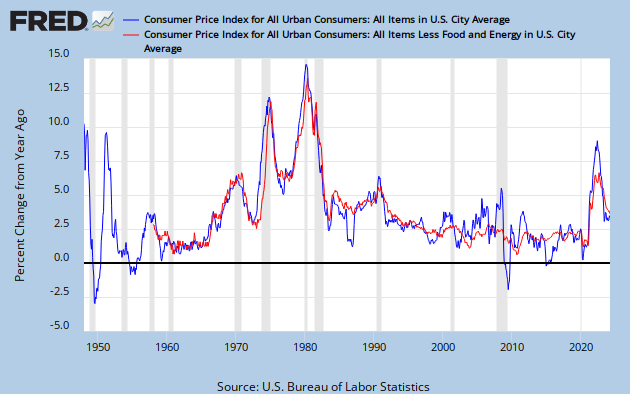
So not surprisingly, for the last twenty years or more, low and stable inflation is exactly what the country got. Even after the Great Recession, the Fed consistently hit its two percent inflation target, even as its counterbalancing mandate to boost employment was essentially ignored:

Arguably, the fundamental problem is the Fed did too good a job at reining in inflation.

Inflation is the natural response of an economy to robust growth, as rising wages put upward pressure on other prices. A Fed devoted to controlling inflation above all else will inevitably also weigh down jobs and wages for working Americans. “Morning in America,” the economic boom of the Reagan years, was accompanied by four percent inflation on average — twice the level we’re seeing now.

The last few decades of low inflation also came alongside stagnating median wages, and a new form of “jobless” recovery that brings back economic growth, but not the job growth of previous post-war recoveries. The result has been a self-reinforcing downward spiral, as stalled wages bring more inequality and less inflation, eliminating the need for a higher federal funds rate and ultimately leaving the Fed with ever less ammunition to boost employment with each successive recession.

Certainly, the Fed’s preference for exceedingly low inflation is not the whole cause behind slow wage growth and rampant inequality. But it’s most likely a big part.


View the original article here

Wednesday, March 20, 2013

The Coming Obamacare Recession

By on 2.6.13 @ 6:09AM

Actually, we already saw it last quarter and there’ll be no escaping it this year.

To the shock of many, U.S. GDP shrank in the fourth quarter of 2012 by 0.1%. Immediately, however, economists and commentators flooded the media with reassuring explanations. Super Storm Sandy reduced economic activity in the areas it ravaged; worries about the fiscal cliff and sequestration dampened business spending and government defense spending; businesses let inventory levels dwindle. Even the Federal Reserve commented that the GDP drop was the result of “weather-related disruptions and other transitory factors.” All this is true, to some extent. But none of the reporting I saw even mentioned the elephant in the room that not only depressed economic activity in the fourth quarter of 2012, but will continue to depress economic activity through 2013 and beyond. That elephant is the “Affordable Care Act,” aka “Obamacare.”

Some of the negatives from the fourth quarter will reverse in the first quarter of 2013. Sandy reconstruction will kick in, and the big drop in defense outlays was probably an anomaly. But business inventories fell in the fourth quarter not because businesses were too pessimistic about demand and let inventories fall too much, but because they had been too optimistic earlier in the year and allowed them to get too high. The idea that business will have to start increasing inventory levels in the first quarter of 2013 in order to meet increasing demand is purely theoretical, and right now, there is precious little evidence to support that theory. On the contrary, lackluster holiday sales do not auger well for consumer spending, and the Conference Board’s index of consumer sentiment fell from a reading of 66.7 in December to 58.6 in January, its lowest reading since November 2011.

The January employment report, which cheered Wall Street due to the upward revision in November and December employment, showed only an increase of 157,000 jobs, which was slightly below expectations and not even high enough to keep up with population growth. Surely, many optimists have argued, the stronger fourth quarter employment numbers show that there must be something wrong with the fourth quarter GDP report and it will surely be revised upwards. Initial GDP reports often do get revised, and it would be no surprise if the fourth quarter is revised upwards, but the employment numbers are not a harbinger of that outcome. An equally valid interpretation of the data is that employers were hiring in the fourth quarter in anticipation of greater economic growth that did not materialize, and if it doesn’t materialize soon, much of those employment gains may be reversed out in 2013.

The American economy is resilient, full of entrepreneurial spirit, despite the best efforts of the Obama administration. The American economy wants to grow, and after four years of recession and faint recovery, a release of pent up demand has resulted in higher spending on autos and on business software and computer systems. But will that continue and will it be sufficient to counter the roadblocks the Obama administration has set up that have proved so effective in retarding economic growth?

Consumer and business spending, which have been rising modestly, will continue to rise if consumers and businesses have confidence in the future. The new year, however, brought with it higher taxes, and not just the increases on income over $400,000 recently won by the Obama forces. Many Obamacare taxes became effective January 1, 2013, including a 0.9% increase in Medicare Taxes and an extra 3.8% tax on investment income, including dividends, interest, capital gains, and rent income, for households earning more than $250,000.

Some of the ugly details of Obamacare, the most far-reaching piece of legislation to be passed without a single member of Congress having actually read it—indeed not even having been allowed a serious chance to read it—have only been gaining attention in recent months. Looking forward to 2014, employers are now looking at an additional $63 per insured employee fee to compensate insurance companies for the added costs of covering previously uninsured people with pre-existing conditions. That’s supposed to phase out by 2017, but if you believe that you probably also bought the line that Obama is in favor of a “balanced” approach to deficit reduction.

Better known is the $2,000 per employee charge that any business with more than 50 full-time employees will have to pay for every full-time employee to whom that business does not provide an Obama-approved health package (though the first 30 such employees are exempted). With all the concern expressed in the media about how the uncertainty posed by the fiscal cliff negotiations negatively affects business, it is odd that so little attention has been focused on the certainty of Obamacare costs that businesses now have to face. Many companies, large and small, have pointed to these provisions, explaining that this is why they won’t be hiring, or won’t be hiring nearly as much in 2013 as they would otherwise. Abbott Labs, Boston Scientific, Welch Allyn, and many other companies have even reported they will be laying off workers directly as a result of Obamacare.

I’m in the commercial real estate business, and have managed commercial properties for more than 20 years. A friend of mine has been in the real estate services business, providing everything from janitorial services to window washing to parking lot repairs for about as long. In fact, the company I work for was his first account. In the last 20 years, he has expanded from a handful of full-time employees to 150 full-time employees. I recently discussed with him his concerns about the effect of Obamacare on his business. Most of his employees are in lower-skill occupations and so only earn $10 - $15 per hour. He cannot afford to tack on health care benefits equal to another $3.50 to $5.50 per hour without going broke. His more affordable alternative would be to pay the $2,000 per employee fee, which would effectively erase his entire 2012 profit from his business. In essence, this one provision is the equivalent of a 90% - 100% tax on his typical net business income. Worse yet, since the law does not allow the $2,000 per employee charge as a deductible business expense, he’ll have to pay federal income tax on approximately $240,000 of business income he didn’t get. Implicit in the law (or perhaps it is explicit) is the notion that it is the responsibility of employers to provide health insurance to their employees, and if they don’t they are bad people, greedy capitalists exploiting the working class, and deserve to be punished.

What is my friend to do? He can raise his prices and risk losing business from people like me who will then need to cut back on his services, or who will go to his smaller competitors with fewer than 50 employees who are not (yet) subject to the fee. Or he can cut back the hours of his employees until he has fewer than 50 working full-time. Or he can fire most of his employees and tell them they are on their own as independent contractors, and he may be able to subcontract with them from time-to-time for specific jobs. None of these alternatives are good for the business owner, his customers, his employees, or the economy in general.

This is what you get when people sheltered all their lives in government and community organizing, with little knowledge of how businesses actually operate, are put in charge of crafting far-reaching economic policies. This is what you get from people who don’t recognize businesses as the drivers of employment, economic growth, and higher standards of living, but see them as entities that need to be regulated, managed, and controlled by government for the “public good.” This is what you get from people who deride the idea that successful businesses are created by their owners working long hours, developing good ideas, and putting capital at risk, but instead are the creations of government and the community at large.

The iniquity of the law, in that it places a much higher burden, as a percentage of payroll costs, on companies in lower-skilled/lower-wage industries versus companies in relatively higher-skilled/higher-wage industries, is one argument against Obamacare. But there is no question that the law delivers pain to almost everyone. Unions, for instance, are now complaining that the requirement to eliminate annual and lifetime benefit caps, a feature in many policies, including many administered by unions, by itself will, by the estimate of one Atlanta area Sheet Metal Workers Union representative interviewed by the Wall Street Journal, push the price of union labor up by $0.50 to $1.00 per hour to cover the extra costs associated with eliminating those caps. Perhaps unions, being friends and supporters of the Obama administration, will be successful in obtaining federal subsidies or further waivers from the law (equality under the law has not been a hallmark of this administration), but the cost will just be shifted somewhere else, such as on to employers or taxpayers, with the same depressing effect on economic activity.

How the economy performs will be determined by more than just Obamacare. There will be other negative factors, such as Europe, which will continue to have bouts of economic turmoil. But there will be positives, as well. The U.S. economy is fundamentally sound and dynamic. It is poised to grow, and has been for years. American corporations, on the whole, are sitting on large cash reserves, looking for opportunities to put that cash to productive use. It will be Obamacare, however, that I fear will be the weight that will matter most. The consensus among economists is that GDP will rebound in the first quarter of 2013 and that GDP growth for the year will be about 2.0%. Unfortunately, I believe that even that dreary prediction will prove too optimistic, and 2013 is more likely to be the year of the Obamacare recession.

?Photo: UPI


View the original article here

Friday, January 18, 2013

Great Recession Forced All Americans To Cut Back On Their Health Care

Although the Great Recession has taken an outsized toll on African-Americans and Hispanics, new research suggests that the economic downturn has forced Americans across all racial groups to equally cut back on their medical services.

After researchers at the University of Maryland analyzed more than 54,000 U.S. adults’ health care use, they found that — despite their assumptions that the demographic groups struggling the most as the result of the Great Recession would also struggle the most to access health care — the declining economy impacted all Americans’ ability to get the care they need. During the recession, the average number of doctor visits and prescription drug refills dropped about the same amount for whites, African-Americans, and Latinos. Visits to the emergency room were also essentially unchanged across all groups.

Of course, that doesn’t mean Americans across all racial and economic groups have equal access to health services. There were significant racial disparities in medical care before the Great Recession hit — for example, while whites visited the doctor an average of about 7 times a year around 2005, the average rate was closer to 5.75 for blacks and 4.5 for Latinos during that time period. African-Americans were, and still remain, more likely to be hospitalized than other groups. Earlier reports from the Census Bureau have found that 40 percent of the Americans living in poverty did not visit a doctor in 2010, and confirmed that Hispanics were the least likely group to make a trip to the doctor’s office that year.

But, as the lead researchers for the new study point out, at least the growing economic inequality between whites and racial minorities during the recent recession hasn’t widened the gulf when it comes to health care. “Although minorities bore the brunt of the recession in terms of losses in employment, income and insurance, our findings suggest that trends in [medical] use patterns were similar across race and ethnicity,” the study concludes.


View the original article here