Showing posts with label Country. Show all posts

Saturday, August 3, 2013

Schumer: Senate immigration bill would make country safer

The Gang of Eight member said their package would help prevent attacks on the homeland.

The Senate's immigration reform package would make the country safer from attacks on home soil, a leading author of the bill said this week.

With Americans still reeling in the aftermath of Monday's Boston Marathon bombings, some Capitol Hill lawmakers are warning that the tragedy should make Congress even more wary of attempts to overhaul the immigration system.

But Sen. Charles Schumer (D-N.Y.), a member of the so-called "Gang of Eight" that negotiated the sweeping proposal, said Friday that their package would help prevent attacks on the homeland.

"Our bill, while certainly it gives a path to citizenship and legalizes people right away, we will know the identities of everybody. And that makes the country safer," Schumer said in an interview with Univision set to air Sunday. "So I think our bill would actually – it's too early to tie it to any specific incident – but overall, it'll make the country a lot safer."

Law enforcement officials say the chief suspects in the Boston bombings are ethnic Chechens who have been living in the United States for years. One suspect, 26-year-old Tamerlan Tsarnaev, was killed in a shootout with police in the early hours of Friday morning. His brother, 19-year-old Dzhokhar Tsarnaev, was captured outside Boston Friday night after an intense manhunt that lasted nearly 24 hours and shut down much of Greater Boston.

Schumer and the other members of the Gang of Eight – four Democrats and four Republicans – unveiled a proposal this week to revamp the nation's immigration system after months of delicate, closed-door talks. The issue has divided Washington politicians for many years, but the senators are hoping their compromise package will be more successful by striking the right balance between strengthening border security, favored by conservative Republicans, and granting new immigrant protections, urged by liberal Democrats.

Still, in the first Senate hearing on the issue, conducted Friday in the Judiciary Committee, there were clear signs that the bill has a tough road ahead. And Sen. Charles Grassley (Iowa), senior Republican on the panel, wondered aloud if holes in the immigration system opened the door for the Boston bombers to pull off their attacks. 

"Given the events of this week, it’s important for us to understand the gaps and loopholes in our immigration system," Grassley said in his opening statement of a Judiciary hearing on reform. "While we don’t yet know the immigration status of the people who have terrorized the communities in Massachusetts, when we find out, it will help shed light on the weaknesses of our system.

"How can individuals evade authorities and plan such attacks on our soil?" Grassley asked. "How can we beef up security checks on people who wish to enter the U.S.?  How do we ensure that people who wish to do us harm are not eligible for benefits under the immigration laws, including this new bill before us?"

Schumer said he's confident there's enough support for immigration reform this year – including endorsements from the strange bedfellows of the U.S. Chamber of Commerce and the AFL-CIO – that the Boston tragedy won't quash the effort. 

"So many groups are behind us. I don't think that this incident would derail the immigration bill," he told Univision.

View Comments

View the original article here

Tuesday, June 25, 2013

How Fed Policy Could Leave The Country At The Mercy Of Another Recession

The Federal Reserve released its statement from the latest Federal Open Market Committee meeting this past week. Its projections see economic growth reaching 3.8 percent at best over the next three years, hovering between two and three percent per year after that, and finally driving unemployment down to between five and six percent after 2015.

None of that is especially new or encouraging. But on Wednesday, Ryan Avent at The Economist pointed out another number in the report that hints at a more subtle, but possibly more pernicious problem. It’s the federal funds rate, which is the interest rate the Fed charges other banks when it lends them money — thereby guiding interest rates throughout the economy — and which has basically been at zero since the Great Recession:

If recovery proceeds as the Fed anticipates, its interest-rate target will remain at near zero until at least 2015. Perhaps more worrying, the FOMC’s best guess at the appropriate, long-run value of the fed funds rate is about 4 percent. That is strikingly low. In each of the past three recessions the Fed has responded by cutting the fed funds rate more than 4 percentage points. A fed funds rate at that level virtually guarantees that the next downturn will result in a relapse into [zero lower bound] territory.

The Fed has a dual mandate to control inflation and maximize employment, and the federal funds rate is the mechanism by which it does both. It can boost the economy by cutting the rate, or rein in inflation by raising the rate. So there’s an inherent balancing act, and the Fed needs room to go in both directions. That’s why, over the past 40 years, the rate only briefly dipped below the four percent mark, and spent most of the boom-time 90s at over five percent:

There’s an imbalance in the Fed’s policy toolkit, in that it can raise the rate as high as it wants to fight inflation, but it can’t cut it past zero to boost the economy and job growth. That’s the problem of the “zero lower bound” Avent refers to. If the rate doesn’t get above four percent, but the Fed needs to cut at least that much to boost the economy, then there’s just not going to be much room to maneuver when the next recession rolls around.

Some economists such as Paul Krugman argue that when monetary policy hits the zero lower bound, fiscal policy (i.e. stimulus spending) becomes the primary tool to help the economy. But others, like Scott Sumner, argue that quantitative easing and other forms of unconventional monetary policy can still work just as well if not better than fiscal policy when the federal funds rate is at zero.

Unfortunately, Republicans are vociferously opposed to both policies. They’ve relentlessly pressured the Fed and Chairman Ben Bernanke to end quantitative easing or even hike the federal funds rate, incessantly warning of runaway inflation that never materializes. There’s also been no real opposing pressure from Democrats or progressives to prioritize job growth. The Fed’s latest form of quantitative easing has been a big step in the right direction, but several members of the governing committee or so skittish they’ve proposed ending it as early as this year.

On top of that, the way the Fed is designed and governed saddles it with additional biases towards cutting inflation over pushing up employment. As an institution, it’s more attuned to the concerns of the financial industry, business owners and the wealthy. Those groups are generally indifferent to sluggish economic growth — they’re the last to lose their homes or livelihoods if the economy implodes or unemployment spikes — but they all have a vested interest in low and stable inflation.

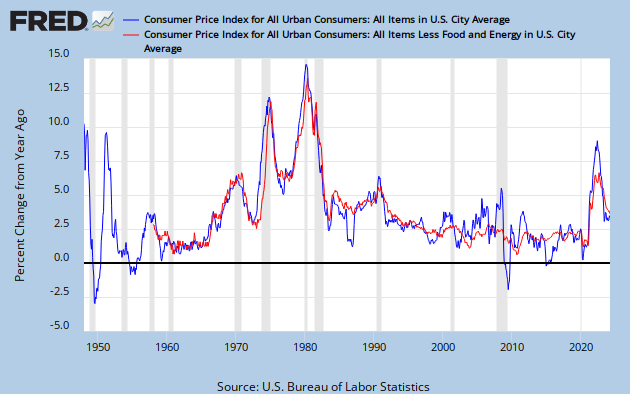
So not surprisingly, for the last twenty years or more, low and stable inflation is exactly what the country got. Even after the Great Recession, the Fed consistently hit its two percent inflation target, even as its counterbalancing mandate to boost employment was essentially ignored:

Arguably, the fundamental problem is the Fed did too good a job at reining in inflation.

Inflation is the natural response of an economy to robust growth, as rising wages put upward pressure on other prices. A Fed devoted to controlling inflation above all else will inevitably also weigh down jobs and wages for working Americans. “Morning in America,” the economic boom of the Reagan years, was accompanied by four percent inflation on average — twice the level we’re seeing now.

The last few decades of low inflation also came alongside stagnating median wages, and a new form of “jobless” recovery that brings back economic growth, but not the job growth of previous post-war recoveries. The result has been a self-reinforcing downward spiral, as stalled wages bring more inequality and less inflation, eliminating the need for a higher federal funds rate and ultimately leaving the Fed with ever less ammunition to boost employment with each successive recession.

Certainly, the Fed’s preference for exceedingly low inflation is not the whole cause behind slow wage growth and rampant inequality. But it’s most likely a big part.


View the original article here

Conservative Pundit Says Country Shouldn’t Move Too Fast In Granting Equal Marriage Rights To Gays

Wall Street Journal columnist Peggy Noonan said this morning that a Supreme Court decision leaving the states to decide whether or not to allow same-sex marriage was in the best interest of Americans, because it would ensure that the country didn’t move too fast in granting equal marriage rights to all of its citizens.
Noonan said on ABC’s This Week that Americans “don’t take it well” when the Supreme Court makes decisions that affect the entire country — such as declaring Proposition 8 unconstitutional or repealing the Defense of Marriage Act — and said one of the “great sins” of Roe v. Wade was that it took power away from the states:

NOONAN: Oh, George Will said something here a few weeks ago, he said, look, opposition is literally dying out — it is the older Americans, not the younger Americans. One of the things that I like by the way about a compromise in which state by state does it, it’s not only about localities and keeping power local — it also takes a little time. Sometimes it’s good when everything takes a little time to settle itself out. May I note, by the way, Ruth Bader Ginsburg, a famous court liberal, her acknowledging very recently, in the “Times” today, that the Roe v. Wade decision, the abortion decision, had gone too far and was an overreach, that is an epic statement.

Noonan’s reference to Ruth Bader Ginsburg came from a speech the Supreme Court justice gave at Columbia Law school last year, in which she said Roe v. Wade went “too far, too fast.” But Noonan’s appeal to let the issue take time to “settle itself out” ignores the fact that activists have been fighting for marriage equality for nearly 40 years. And her insinuation that Americans won’t like it if the Court declares a ban on same-sex marriage unconstitutional ignores that support for marriage equality is at an all time high: a Washington Post-ABC News poll found 58 percent of Americans support gay marriage rights, up from 37 percent in 2003. That 58 percent includes 81 percent of youth, which lends credibility to Noonan’s insight that opposition to marriage equality is dying out.


View the original article here

Saturday, February 23, 2013

Paul Ryan Embraces Spending Cuts He Said Would Devastate The Country

During an interview on Meet The Press on Sunday, Rep. Paul Ryan (R-WI) predicted that the sequester cuts are “going to happen” and made no concrete proposals for how to avoid the reductions. The tone represents a sharp rhetorical and policy shift for the onetime GOP vice presidential nominee, who warned during the 2012 presidential campaign that the cuts would “devastate” the country and undermine job growth.

“I think the sequester is going to happen,” Ryan said, referring to the $1.2 trillion in automatic spending cuts to the Pentagon and other government agencies that will go into effect unless Congress approves offsets. He charged that Democrats rejected the GOP’s replacement legislation — the bill cut the food-stamp program, slashed Medicaid, undermined funding for the Affordable Care Act and disaster relief — and failed to produce their own alternatives:

RYAN: If Mitt Romney and I won the election, they would not have happened. You know why? Because we would have gone and worked with Democrats and Republicans in Congress to actually put the budget on a path to balance and would have saved defense. So where are we now? I think the sequester is going to happen because that $1.2 trillion in spending cuts, we can’t lose those spending cuts. [...] But we think these sequesters will happen because the Democrats have opposed our efforts to replace those cuts with others and they’ve offered no alternatives.

In fact, Democrats introduced offsets in the hopes of reaching a grand bargain that could turn off the sequester and avoid the so-called fiscal cliff.

Days before House Speaker John Boehner (R-OH) abandoned negotiations with President Obama to advance his failed Plan B, the White House paired a tax increase on the richest Americans with spending cuts of $1.22 trillion over 10 years, including “adopting a new measure of inflation that slows the growth of government benefits, especially Social Security.” Despite Ryan’s claims, the Democrats’ plan contained: $400 billion in savings “from federal health care programs; $200 billion from other so-called mandatory programs, like farm price supports, not subject to Congress’s annual spending bills; $100 billion from military spending; and $100 billion from domestic programs under Congress’s annual discretion.”

Ryan also reiterated that Republicans won’t support additional revenues to turn off the sequester, noting that the American Taxpayer Relief Act — the last minute law that averted the fiscal cliff — included an increase in taxes on couples making more than $450,000 annually and singles making more than $400,000. “The point is, though, the president got his additional revenues. So that’s behind us,” Ryan said on Sunday.

The comments represent another retreat for Ryan, who backed Mitt Romney’s proposal to raise revenues by eliminating tax loopholes and deductions for the wealthiest Americans. Those reforms were not included in the American Taxpayer Relief Act and could be part of a package that reforms tax breaks for high-income individuals and corporations, generating “$1 trillion in potential savings over 10 years” — more than enough to replace the sequester.


View the original article here