Showing posts with label Reasons. Show all posts

Tuesday, August 13, 2013

24 million reasons to protect immigrant whistle-blowers

In a U.S. economy where tens of millions are struggling, guest workers on H-2B visas are trapped at the bottom. These so-called “low skilled” temporary workers occupy fields from hospitality to construction to landscaping to food processing — alongside 24 million U.S. workers in the same sectors. And the job quality of those 24 million depends on whether guest workers can blow the whistle on abuse. To understand why, take Ana Diaz. Ana came to the United States from Mexico last year as an H-2B guest worker. Ana peeled crawfish for a Wal-Mart supplier in Louisiana who subjected her and her fellow guest workers to shifts of up to 24 hours with no overtime pay. Supervisors locked them into the plant to prevent breaks, and threatened to beat them with a shovel to make them work faster. When workers complained, the boss responded with threats of violence against them and their families.

Ana’s story is far from unique. The National Guestworker Alliance has worked with thousands of guest workers facing severe employer abuse, from wage theft to forced labor. When workers try to blow the whistle, employers retaliate to scare them into silence.

Big business is seeking access to as many cheap, exploitable guest workers as possible through immigration reform. The current Senate immigration bill is set to give them just that. The bill would hugely expand the H-2B program over the next four years, from 66,000 workers to 264,000, without providing key protections for H-2B whistle-blowers.

Why does this matter for U.S. workers? Because the conditions of workers at the bottom of the U.S. economy — guest workers like Ana — help determine the job quality of the more than 24 million U.S. workers who work alongside them in the same sectors. When employers can get away with exploiting guest workers, it forces U.S. workers into a race to the bottom, driving down wages and conditions for all.

Americans already know this. In a national poll this March, 75 percent agreed that “if employers are allowed to get away with mistreating immigrant workers, it ends up lowering wages and hurting conditions for American workers as well.” In the same poll, 89 percent agreed that “immigration reform should protect the rights of both U.S. born and immigrant workers, because all workers deserve dignity and freedom from exploitation.” Eighty percent agreed that “immigrant workers who blow the whistle on abusive employers are helping defend workplace standards and should have the opportunity to stay in the U.S. to work towards citizenship.”

Tens of millions of U.S. workers already feel the floor falling. Their wages, conditions, and job security are eroding every day. If the workers at the bottom don’t have basic whistle-blower protections, the bottom will continue to fall. At the end of this process, all work in America would look like guest work: low-wage, unstable and deeply exploitative.

But when guest workers can stand up against employer abuse, they help lift the floor for all workers. Wages and conditions are more secure. Ana and her fellow guest workers showed real bravery last June, defying threats of violence, deportation and blacklisting to go public about the abuse they endured. By becoming whistle-blowers, they helped both to protect other guest workers from abuse, and to secure the job quality of millions of U.S. workers.

Whistle-blowers like Ana are standing up to help protect American workers. Shouldn’t American workers stand up to protect them?

Sen. Richard Blumenthal (D-Conn.) has introduced an amendment to the Senate immigration bill that would do just that. It would provide key protections to let H-2B whistle-blowers stand up against employer abuse without fear of retaliation. Sens. Charles Schumer (D-N.Y.) and Chuck Grassley (R-Iowa) responded with a clear show of bipartisan support for the amendment, but it has yet to be added to the bill.

It is critical that the Senate immigration bill include these protections — for the future of all America’s workers.

Soni is executive director of the National Guestworker Alliance.

View Comments

View the original article here

Saturday, June 29, 2013

Talk:Essay: 10 reasons why American atheism will see a significant decline

(Difference between revisions)The newly updated 2012 "Status of Global Mission" report states that atheism is now losing 800 adherents per day rather than the 300 reported in the 2011 IBMR. Also, agnosticism is losing 1,100 adherents per day (I know the article is about atheism, but the agnostic statistic shows decline in secularism as well, good statistic for other articles.)  Here's the link http://www.gordonconwell.edu/resources/CSGC-Resources.cfm -Clint::Clint, I do believe there are a number of factors that will cause [[global atheism]] to lose adherents at an accelerating rate. For example, creation evangelism is likely to increase.[http://questionevolution.blogspot.com/2012/05/evoolutionists-will-soon-by-behind-8.html]  However, could you give me the precise link rather than the general link to the various resources as far as the statistics you gave?  This link is a more general link: http://www.gordonconwell.edu/resources/CSGC-Resources.cfm A more precise URL would be appreciated and I will update content at Conservapedia if it is warranted. [[User:Conservative|Conservative]] 15:16, 15 May 2012 (EDT)::::Here is a more precise link http://www.gordonconwell.edu/resources/documents/StatusOfGlobalMission.pdf. Also notice that the number of Christians increases 83,000 per day, a 3,000 per day increase since the last "Status of Global Mission" report. -Clint:::Clint, that is very good news. I think it can be doubled to 1,600 less atheist a day though greater evangelism in Asia, increased [[internet evangelism]], greater creation evangelism, Christian apologetics having a more prominent profile on the internet and Western Christians doing more evangelism in their communities. I think Western Christianity has been too passive when it comes to evangelism in the West and in confronting atheism. Atheism is one of the easiest worldviews to dispel and that is why prominent atheists and evolutionists are chicken to debate. See: [[Atheism and cowardice]]. Global atheism is extremely vulnerable right now and its vulnerability will likely increase with time. Have you seen the Eric Kaufmann material I posted yet? See: [[Decline of atheism]]? [[User:Conservative|Conservative]] 15:54, 15 May 2012 (EDT)::::I actually own the book, Shall the Religious Inherit the Earth? It was very interesting to see the different birthrates of atheist parents vs. Christian parents. -Clint:::Clint, who produced this document as it gives no authors or organizational name: http://www.gordonconwell.edu/resources/documents/StatusOfGlobalMission.pdf [[User:Conservative|Conservative]] 16:18, 15 May 2012 (EDT)Clint, forget my last request. The rate at which global atheism is declining is increasing rapidly according to respected seminary Gordon-Conwell Theological Seminary (GCTS) which publishes these statistics in January of every calendar year.The International Bulletin of Missionary Research (IBMR) obtains their data from GCTS reports.In February of 2011, the American Spectator reported that according to IBMR every day there were 300 less atheists a day as can be seen here: http://spectator.org/archives/2011/02/28/thriving-christianity  I discovered that this came from the GCTS January 2011 report.In 2012, you showed me that a report from Gordon-Conwell Theological Seminary showed that each day there are 800 less atheists a day as can be seen here: http://www.gordonconwell.edu/resources/documents/StatusOfGlobalMission.pdf  [[User:Conservative|Conservative]] 16:51, 15 May 2012 (EDT)::::Ok, no problem. I'm just trying to get the good word out about the Good News! -ClintClint, I added your material to relevant Conservapedia articles. [[User:Conservative|Conservative]] 21:24, 19 May 2012 (EDT)== One thing you need to clarify ==You keep referring to the "leadership" of the atheist movement. What you haven't clarified is how many atheists consider themselves a part of this movement, and are followers of men like Dawkins and Myers, and how many atheists are ''not'' involved with any organized group, and are unaffected by anything it does. I have a feeling there are many more who fall outside of any organization, and who don't give much thought to God or religion or even their own lack of belief, or outright disbelief. --[[User:SharonW|SharonW]] 10:14, 28 October 2011 (EDT):::I have never claimed the atheist movement has strong leadership.  In fact, it could be argued that I have argued the opposite (for example, [[Atheism and cowardice]]). Plus, I wrote this article: [[Atheist factions]]. Nevertheless, your "herding cats" comment is a valid point. [[User:Conservative|Conservative]] 10:43, 28 October 2011 (EDT)::::::SharonW, thanks. I added this sentence: "In addition, there is a lot of disharmony in the atheist movement (see: [[Atheist factions]] and [[Essay: Atheism: A house divided and in global decline|Atheism: A house divided and in global decline]])". [[User:Conservative|Conservative]] 10:47, 28 October 2011 (EDT)::::My point was actually not that there was disharmony, but that many people are apolitical, and don't pay attention to anything outside of their own lives. They're just not involved with any movements, or organizations, and many people who might consider themselves agnostic or atheist aren't even aware of these so-called leaders or organizations for atheists. --[[User:SharonW|SharonW]] 14:30, 28 October 2011 (EDT):::::Wired magazine made the observation that atheists [[Atheism and women|tend to be quarrelsome, socially challenged males]] which would lend some support to what you have to say - as in "herding cats". [[User:Conservative|Conservative]] 15:18, 28 October 2011 (EDT):::::::Thanks Sharon, I added this material: "[[Wired (magazine)|Wired]] magazine made the observation that atheists tend to be [[Atheism and women|quarrelsome, socially challenged men.]] " [[User:Conservative|Conservative]] 15:26, 28 October 2011 (EDT)::::::::Talk about completely missing the point. What she was saying is that most atheists aren't part of any "atheist movement." They just don't believe in gods.--[[User:RayFlagherty|RayFlagherty]] 08:16, 23 February 2012 (EST)I don't think the atheists are ready for battle; it's like they got their middle ages armor on while they do an uphill climb on a grease-covered mountain as they read the wrong manuals on how to fight!  [[User:Karajou|Karajou]] 01:26, 7 November 2011 (EST):::Yes, the allies of atheism/evolutionism are getting weaker (liberal press, etc.) plus the atheists/evolutionists are totally unprepared for the onslaught of a grassroots campaign like the [[Question evolution! campaign]]. [[User:Conservative|Conservative]] 02:44, 7 November 2011 (EST)Atheists seem intent that there is no God- all while believing that we come from pond slime. They claim that God is some fairy tale that people made up while believing something easily as seemingly impossible. They should really actually listen to and debate creationists, instead of laughing them off as crazy lunatics.--[[User:JamesWilson|James Wilson]] 16:16, 12 November 2011 (EST)User:Conservative, could you please clean up the references? They look really messy! [[User:AugustO|AugustO]] 08:04, 23 February 2012 (EST)::AugustO, thanks. Footnote #5 looked "messy" plus I got rid of two bare links as footnotes. Other than that I think the footnotes are fine in terms of formatting and I will keep them the same. [[User:Conservative|Conservative]] 18:45, 26 February 2012 (EST):Just the references? If you ask me the whole article's a mess. --[[User:RayFlagherty|RayFlagherty]] 08:13, 23 February 2012 (EST):::Ray, can you offer us better demographic analysis than Eric Kaufmann on the expected "great shrinking" of [[global atheism]] and how he expects it will affect Western atheism? Does Eric Kaufmann say that atheism will shrink at an increasing rate in the future? Is global atheism shrinking now? Is the [[Atheist Population|atheist population]] esteemed by the American public now? What did Sam Harris say how the American public views atheists? Among various worldviews did a reputable survey say that atheists were the least trusted group in America?  [[User:Conservative|Conservative]] 18:35, 26 February 2012 (EST)@User:Conservative: '' Other than that I think the footnotes are fine in terms of formatting and I will keep them the same. '' They aren't and you shouldn't:*Footnotes 3 & 4 are identical*Footnotes 5 & 10 are identical*Footnotes 11 & 12 are identicalIf don't know how to handle multiple occurrences of a single source, I'm happy to give a link to a basic tutorial. [[User:AugustO|AugustO]] 01:47, 28 February 2012 (EST):::I am really not into using the wiki footnoting format where one footnote is used for multiple citations. It makes it hard for future editing sometimes. Ibid makes sense for footnotes in offline papers though. Sorry, just a preference of mine. [[User:Conservative|Conservative]] 03:02, 28 April 2012 (EDT)== Gallup survey shows American atheism is on the rise! ==This [http://www.wingia.com/web/files/richeditor/filemanager/Global_INDEX_of_Religiosity_and_Atheism_PR__6.pdf Win/Gallup International Association survey] (not Gallup Inc. based in the United States. In fact, Gallup Inc. and Gallup International Association are involved in a legal dispute over the use of the Gallup name) invalidates all 10 reasons, because it shows that American atheism is on the rise. [[User:Richman|Richman]] 18:27, 22 September 2012 (EDT)::Let me know when you are ready to cite survey data from competent researchers: [http://questionevolution.blogspot.com/2012/08/another-major-flaw-found-in-survey.html Another major flaw found in a survey which claimed global atheism is rising] [[User:Conservative|Conservative]] 18:46, 22 September 2012 (EDT):::Conservative, would you be so kind as to clarify what error your source is indicating? Maybe I'm just not reading it right, but the problem with the survey that your link seems to indicate is not really phrased in a way that makes sense to me. I don't want to make a judgment here without fully understanding the criticism, so I'm just hoping to get some clarification! Thanks.--[[User:DTSavage|DTSavage]] 19:19, 22 September 2012 (EDT)My guess is that you did not read all three articles via that web resource. It will become apparent how shoddy various claims of theirs are based on the data they gathered. [[User:Conservative|Conservative]] 22:54, 22 September 2012 (EDT)::::So if I'm reading the articles correctly, the main criticism is that of a small sample size used for extrapolation, both in number of persons and number of countries surveyed. Is that correct?--[[User:DTSavage|DTSavage]] 23:09, 22 September 2012 (EDT)::::Addendum: In looking through the history of this talk page in attempting to determine what your five consecutive edits were, I note that you have edited the comment of another user, namely [[User:Richman|Richman]]. Without any other understanding of the reasoning before this behavior, I would like to note that I find this morally questionable behavior, at the very least.--[[User:DTSavage|DTSavage]] 23:20, 22 September 2012 (EDT):::::Please write an abstract for each of the three articles. [[User:Conservative|Conservative]] 00:20, 23 September 2012 (EDT)if (window.showTocToggle) { var tocShowText = "show"; var tocHideText = "hide"; showTocToggle(); }

The newly updated 2012 "Status of Global Mission" report states that atheism is now losing 800 adherents per day rather than the 300 reported in the 2011 IBMR. Also, agnosticism is losing 1,100 adherents per day (I know the article is about atheism, but the agnostic statistic shows decline in secularism as well, good statistic for other articles.) Here's the link http://www.gordonconwell.edu/resources/CSGC-Resources.cfm -Clint

Clint, I do believe there are a number of factors that will cause global atheism to lose adherents at an accelerating rate. For example, creation evangelism is likely to increase.[1] However, could you give me the precise link rather than the general link to the various resources as far as the statistics you gave? This link is a more general link: http://www.gordonconwell.edu/resources/CSGC-Resources.cfm A more precise URL would be appreciated and I will update content at Conservapedia if it is warranted. Conservative 15:16, 15 May 2012 (EDT) Here is a more precise link http://www.gordonconwell.edu/resources/documents/StatusOfGlobalMission.pdf. Also notice that the number of Christians increases 83,000 per day, a 3,000 per day increase since the last "Status of Global Mission" report. -Clint Clint, that is very good news. I think it can be doubled to 1,600 less atheist a day though greater evangelism in Asia, increased internet evangelism, greater creation evangelism, Christian apologetics having a more prominent profile on the internet and Western Christians doing more evangelism in their communities. I think Western Christianity has been too passive when it comes to evangelism in the West and in confronting atheism. Atheism is one of the easiest worldviews to dispel and that is why prominent atheists and evolutionists are chicken to debate. See: Atheism and cowardice. Global atheism is extremely vulnerable right now and its vulnerability will likely increase with time. Have you seen the Eric Kaufmann material I posted yet? See: Decline of atheism? Conservative 15:54, 15 May 2012 (EDT) I actually own the book, Shall the Religious Inherit the Earth? It was very interesting to see the different birthrates of atheist parents vs. Christian parents. -Clint Clint, who produced this document as it gives no authors or organizational name: http://www.gordonconwell.edu/resources/documents/StatusOfGlobalMission.pdf Conservative 16:18, 15 May 2012 (EDT)

Clint, forget my last request.

Here is why:

The rate at which global atheism is declining is increasing rapidly according to respected seminary Gordon-Conwell Theological Seminary (GCTS) which publishes these statistics in January of every calendar year.

The International Bulletin of Missionary Research (IBMR) obtains their data from GCTS reports.

In February of 2011, the American Spectator reported that according to IBMR every day there were 300 less atheists a day as can be seen here: http://spectator.org/archives/2011/02/28/thriving-christianity I discovered that this came from the GCTS January 2011 report.

In 2012, you showed me that a report from Gordon-Conwell Theological Seminary showed that each day there are 800 less atheists a day as can be seen here: http://www.gordonconwell.edu/resources/documents/StatusOfGlobalMission.pdf Conservative 16:51, 15 May 2012 (EDT)

Ok, no problem. I'm just trying to get the good word out about the Good News! -Clint

Clint, I added your material to relevant Conservapedia articles. Conservative 21:24, 19 May 2012 (EDT)

You keep referring to the "leadership" of the atheist movement. What you haven't clarified is how many atheists consider themselves a part of this movement, and are followers of men like Dawkins and Myers, and how many atheists are not involved with any organized group, and are unaffected by anything it does. I have a feeling there are many more who fall outside of any organization, and who don't give much thought to God or religion or even their own lack of belief, or outright disbelief. --SharonW 10:14, 28 October 2011 (EDT)

I have never claimed the atheist movement has strong leadership. In fact, it could be argued that I have argued the opposite (for example, Atheism and cowardice). Plus, I wrote this article: Atheist factions. Nevertheless, your "herding cats" comment is a valid point. Conservative 10:43, 28 October 2011 (EDT) SharonW, thanks. I added this sentence: "In addition, there is a lot of disharmony in the atheist movement (see: Atheist factions and Atheism: A house divided and in global decline)". Conservative 10:47, 28 October 2011 (EDT) My point was actually not that there was disharmony, but that many people are apolitical, and don't pay attention to anything outside of their own lives. They're just not involved with any movements, or organizations, and many people who might consider themselves agnostic or atheist aren't even aware of these so-called leaders or organizations for atheists. --SharonW 14:30, 28 October 2011 (EDT) Wired magazine made the observation that atheists tend to be quarrelsome, socially challenged males which would lend some support to what you have to say - as in "herding cats". Conservative 15:18, 28 October 2011 (EDT) Thanks Sharon, I added this material: "Wired magazine made the observation that atheists tend to be quarrelsome, socially challenged men. " Conservative 15:26, 28 October 2011 (EDT) Talk about completely missing the point. What she was saying is that most atheists aren't part of any "atheist movement." They just don't believe in gods.--RayFlagherty 08:16, 23 February 2012 (EST)

I don't think the atheists are ready for battle; it's like they got their middle ages armor on while they do an uphill climb on a grease-covered mountain as they read the wrong manuals on how to fight! Karajou 01:26, 7 November 2011 (EST)

Yes, the allies of atheism/evolutionism are getting weaker (liberal press, etc.) plus the atheists/evolutionists are totally unprepared for the onslaught of a grassroots campaign like the Question evolution! campaign. Conservative 02:44, 7 November 2011 (EST)

Atheists seem intent that there is no God- all while believing that we come from pond slime. They claim that God is some fairy tale that people made up while believing something easily as seemingly impossible. They should really actually listen to and debate creationists, instead of laughing them off as crazy lunatics.--James Wilson 16:16, 12 November 2011 (EST)

User:Conservative, could you please clean up the references? They look really messy! AugustO 08:04, 23 February 2012 (EST)

AugustO, thanks. Footnote #5 looked "messy" plus I got rid of two bare links as footnotes. Other than that I think the footnotes are fine in terms of formatting and I will keep them the same. Conservative 18:45, 26 February 2012 (EST) Just the references? If you ask me the whole article's a mess. --RayFlagherty 08:13, 23 February 2012 (EST) Ray, can you offer us better demographic analysis than Eric Kaufmann on the expected "great shrinking" of global atheism and how he expects it will affect Western atheism? Does Eric Kaufmann say that atheism will shrink at an increasing rate in the future? Is global atheism shrinking now? Is the atheist population esteemed by the American public now? What did Sam Harris say how the American public views atheists? Among various worldviews did a reputable survey say that atheists were the least trusted group in America? Conservative 18:35, 26 February 2012 (EST)

@User:Conservative: Other than that I think the footnotes are fine in terms of formatting and I will keep them the same. They aren't and you shouldn't:

Footnotes 3 & 4 are identical Footnotes 5 & 10 are identical Footnotes 11 & 12 are identical ditto footnotes 23 & 24

If don't know how to handle multiple occurrences of a single source, I'm happy to give a link to a basic tutorial. AugustO 01:47, 28 February 2012 (EST)

I am really not into using the wiki footnoting format where one footnote is used for multiple citations. It makes it hard for future editing sometimes. Ibid makes sense for footnotes in offline papers though. Sorry, just a preference of mine. Conservative 03:02, 28 April 2012 (EDT)

This Win/Gallup International Association survey (not Gallup Inc. based in the United States. In fact, Gallup Inc. and Gallup International Association are involved in a legal dispute over the use of the Gallup name) invalidates all 10 reasons, because it shows that American atheism is on the rise. Richman 18:27, 22 September 2012 (EDT)

Let me know when you are ready to cite survey data from competent researchers: Another major flaw found in a survey which claimed global atheism is rising Conservative 18:46, 22 September 2012 (EDT) Conservative, would you be so kind as to clarify what error your source is indicating? Maybe I'm just not reading it right, but the problem with the survey that your link seems to indicate is not really phrased in a way that makes sense to me. I don't want to make a judgment here without fully understanding the criticism, so I'm just hoping to get some clarification! Thanks.--DTSavage 19:19, 22 September 2012 (EDT)

My guess is that you did not read all three articles via that web resource. It will become apparent how shoddy various claims of theirs are based on the data they gathered. Conservative 22:54, 22 September 2012 (EDT)

So if I'm reading the articles correctly, the main criticism is that of a small sample size used for extrapolation, both in number of persons and number of countries surveyed. Is that correct?--DTSavage 23:09, 22 September 2012 (EDT) Addendum: In looking through the history of this talk page in attempting to determine what your five consecutive edits were, I note that you have edited the comment of another user, namely Richman. Without any other understanding of the reasoning before this behavior, I would like to note that I find this morally questionable behavior, at the very least.--DTSavage 23:20, 22 September 2012 (EDT) Please write an abstract for each of the three articles. Conservative 00:20, 23 September 2012 (EDT)

View the original article here

Friday, June 7, 2013

Five Reasons Washington Shouldn’t Panic About The Debt

Once again, the March budget season has arrived, and Rep. Paul Ryan (R-WI) has engineered another draconian fiscal vision for the House Republicans. The plan would radically remake Medicare, decimate Medicaid, grant a huge tax cut to the wealthy, and slash support for the poor, investments, and civic infrastructure.

Ryan and his cohorts justify these plans by insisting that America faces a “debt crisis,” that the deficits we’re currently running are too high, and that we must act immediately to fix these problems. Centrists and other “serious” pundits and lawmakers throughout Washington have bought this argument, if not all the details of Ryan’s specific solution, and they’ve scoffed at President Obama’s insistence that we don’t actually face a looming debt crisis. Here are the reasons Obama’s right, and they’re all wrong:

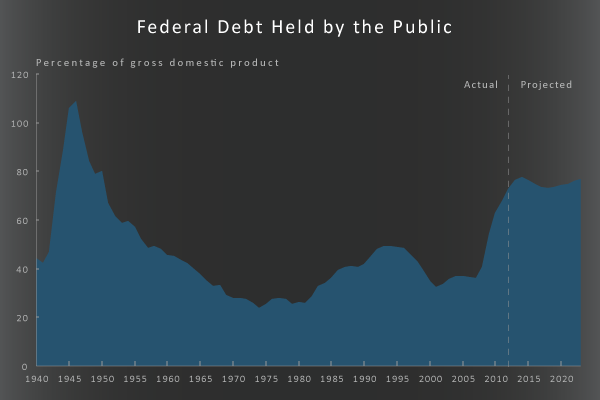
1. We don’t ever have to actually eliminate the debt: The United States ran up a huge debt burden in World War II. More importantly, in raw dollar terms, we never repaid that debt. We simply grew the economy so that the size of the debt fell in comparison. That’s what’s happening in graphs where the debt burden drops in the post-war years. That burden is measured as a ratio of debt-to-GDP, and in ratios the denominator matters as much as the numerator.

2. The budget doesn’t actually have to balance to reduce it: If we can keep deficits under a certain threshold every year, then economic growth will overtake it, meaning our debt-to-GDP ratio will either stay the same or even drop. For the immediate future, the economic looks set to grow by about 4 percent a year. If we can keep each year’s deficit to 4 percent or less of public debt already held, debt-to-GDP will stabilize. America can, in fact, run deficits in perpetuity.

3. The debt is already as balanced as it needs to be: Federal spending involves a host of programs called “stabilizers” — spending that automatically kicks in when the economy tanks, without any acts on the part of lawmakers, boosting GDP growth and helping Americans who have lost their jobs. These include unemployment insurance, food stamps, welfare, Medicaid, and many others. Tax revenues also naturally fall as unemployment rises.

The Congressional Budget office just released a report that stabilizers will add $422 billion to the deficit in 2013. That leaves $423 billion — out of the estimated $845 billion deficit for the year — that isn’t due to the automatic stabilizers. Publicly held U.S. debt is currently around $11.5 trillion, and $423 is less than 4 percent of that.

Take out the stabilizers, and the deficit is within the window necessary to stabilize the debt. And all we have to do to unwind the stabilizers is get the economy firing on all cylinders again. This holds true for about the next decade, before growth in Social Security, Medicare, and Medicaid finally begin to slowly overtake it. The country still has problems, but it has lots of time to sort them out.

4. The “debt crisis” is not a certainty: Paul Ryan may talk as if it is, but it’s merely a projection — one possible result if the CBO’s guesswork about the future proves accurate. The Center for American Progress recently dove into CBO’s methodology, and found that the projections build in a host of sometimes-dramatic assumptions about Congress’ future spending and taxation choices, as well as other factors that could very well not come to pass.

Beyond trying to predict future Congress’ policy preferences, much of the future debt is based on projections that health care costs will continue growing at their previous trend. But the whole point of health care reform is to alter that trend by altering health care markets. Obamacare may already be doing this. CBO’s projections for Medicare spending over the next decade dropped by $500 billion between 2010 and 2013, simply because health care cost growth unexpectedly slowed.

In fact, if that slowdown becomes the new norm, Medicare spending will stay essentially flat as a share of the economy from here on out. That doesn’t show up in CBO’s long-term projections because their methodology uses cost growth over the last two decades to predict future trends. (See page 60.) It’s literally within the realm of reasonable possibility that the long-term debt problem is already solved — all without lawmakers having to cut a dime.

5. We don’t know how much debt actually causes crisis: Ryan and others often cite a finding that economic growth slows as debt-to-GDP reaches 90 percent. But there’s a big correlation-causation problem with this. Remember the denominator: slowing GDP, regardless of debt, could raise debt-to-GDP just as much as higher debt could. And the countries that fit with the 90 percent threshold prediction also present an apples-to-oranges problem when compared to America. Britain, Japan, and France — advanced democracies like ours, with their own currency — shouldered debt levels far in excess of 90 precent over extended periods of time in the past. No debt crisis arrived.

In conclusion: the “debt crisis” is a mere phantom — only one of many possible futures, and far from a certainty. The interest America is paying on its debt is currently lower than it was in the 1990s, despite a lower debt-to-GDP ratio then. When inflation is factored in, current real interest rates on our debt are negative. Financial markets are willing to pay us to borrow from them.

Meanwhile, every dollar we cut — nay, every dollar we fail to borrow — is a dollar that isn’t going to shore up the safety net, to rebuild the country’s infrastructure, or to support struggling Americans while their livelihoods remain on the line. That we’re passing on this opportunity to repair our country, much less even considering the monstrosity that is the Ryan budget, really is absurd.


View the original article here

Thursday, May 30, 2013

Good And Green Reasons To Buy An Electric Car This Year

By Felix Kramer and Max Baumhefner, via Switchboard

When it comes to consumer products, environmentalists generally don’t encourage people to buy new and buy now. But that’s what we’re about to do because electric cars are significantly cleaner than gasoline vehicles, and driving one can save you serious cash at the pump.

Perhaps you’ve already thought about buying an electric car, but dismissed the idea for one reason or another. Let’s look at some common misconceptions, and offer some good reasons why you might want to reconsider:

“I should drive my current car into the ground.”

“Hold on,” you say to yourself, “I already own a car that gets 25 miles a gallon. I want to get my money’s worth from the investment.” The sooner you start saving gas, the better it is for the planet and your pocketbook. There’s no use in throwing good money after bad at the pump, and the sooner you sell your current car, the less money you’ll lose to depreciation.

“I’d just be switching my pollution from the tailpipe to the power plant.”

If you want to go green, driving on electricity is a clear winner. Using today’s average American electricity mix of natural gas, coal, nuclear, hydro, wind, geothermal, and solar, an electric car emits half the amount of climate-changing carbon pollution per mile as the average new vehicle. In states with cleaner mixes, such as California, it’s only a quarter as much. To find out how clean your electric car would be today, plug your zip code into the EPA’s “Beyond Tailpipe Emissions Calculator.” You should also know that, because old coal plants are increasingly being retired and replaced by cleaner and renewable resources, plug-in cars are the only cars that become cleaner as they age.

“What I save on gas, I’ll pay in electricity.”

On average US residential electricity rates, driving one of today’s electric cars is the equivalent of driving a 27 mile-per-gallon car on buck-a-gallon gasoline. It’s been that way for the last four decades, and is forecasted to stay that way for the next three decades. Experts basically throw up their hands when asked to predict the price of gas next year, let alone 30 years from now. One thing we do know: the price at the pump will jump up and down due to geopolitical events beyond our control. If you’re tired of that rollercoaster, call your local utility to ask about electricity rates designed for plug-in cars.

“I’ll hold off until prices go down and there are more places to charge.”

If you’re thinking you’d be better off waiting for a cheaper, better electric car, and a charging station on every block, consider the following:

Modern electric cars start well below $30,000. Even better, there’s a federal tax credit worth $7,500, and states like California have rebates of up to $2,500 — which means you can buy an electric car for under $20,000, or lease one at a very attractive price. Still thinking of waiting for a better deal? Those incentives won’t last forever.A variety of high-quality electric cars are available today. There are over 80,000 of them on America’s streets, with the Chevy Volt, Nissan Leaf, Toyota Prius Plug-in, and Tesla Model S leading the pack.Public charging stations are proliferating rapidly, but you don’t need to wait for them to be as abundant as gas stations. Drivers of plug-in cars enjoy fuel that comes to them, relying on home charging to meet the vast majority of their needs.

“I often need to drive farther than electric vehicles can go without recharging.”

Broadly speaking, electric cars come in two flavors: all-electric and plug-in hybrid. The second has no range limitations whatsoever; they have batteries sufficient for normal trips (between 10 and 40 miles, depending on the model), and they become efficient gasoline hybrids for longer trips. If you want one car to do it all, a plug-in hybrid like the Chevy Volt, Toyota Prius Plug-in, Honda Accord Plug-in, Ford Fusion Energi, or Ford C-Max Energi is a great option.

If, however, your household has more than one vehicle, an all-electric is an ideal “second car” you’ll end up using most of the time. All-electrics, such as the Nissan Leaf, Ford Focus EV, Mitsubishi-i, BMW Active-E, Fiat 500 EV, Coda, Chevy Spark EV, Honda Fit EV, or Tesla Model S, have ranges between 60 and 265 miles, more than enough for the daily commute. When it comes time for the long road trip, you can always take the other car.

When you get behind the wheel of an electric car, you’ll experience the joy of full torque from a standstill and a super-quiet cabin. You may have a hard time going back to a machine that relies exclusively on thousands of explosions of fossil fuel every minute.

If you’d like to try a plug-in outside of a dealership, you can find an owner on DrivingElectric.org to give you a spin. You’ll be surprised in ways you could never expect, and you’ll never get tired of driving on a clean fuel for the equivalent of buck-a-gallon gas.

Felix Kramer is an entrepreneur who founded CalCars.org in 2002 to promote plug-in hybrids, and DrivingElectric.org in 2002 to connect curious people with enthusiastic plug-in drivers. Max Baumhefner is a Sustainable Energy Fellow with NRDC. This piece is reprinted from Switchboard with permission.

jQuery(document).ready(function(){jQuery('#comment_submit').click(function(){if(jQuery('#comment_check:checked').length

View the original article here

Monday, May 13, 2013

5 Reasons ObamaCare Will Add Far More To Deficits

"This is how a country goes broke. It's also how the economy and jobs are destroyed," Sen. Jeff Sessions said Tuesday in response to a report by the... View Enlarged Image

On Tuesday, Sen. Jeff Sessions touted a government report that blew a $6.2 trillion hole in President Obama's promise that his signature health reform wouldn't add a dime to the deficit.

According to the report by the Government Accountability Office, that promise rested entirely on several cost-control mechanisms in ObamaCare that almost no one thinks will work.

Medicare's trustees, the Congressional Budget Office and even Obama's own chief health care actuary "all expressed concerns about whether certain cost-containment mechanisms ... can be sustained," the GAO said.

The law, for example, assumes that economywide gains in productivity will justify slashing Medicare provider payments.

But as the GAO points out, health care has never kept track with such gains because of the "labor intensive nature of the industry and the individual customization of treatments."

Other cost saving measures, the GAO points out, are based on ideas that haven't even been tested, such as the so-called "accountable care organizations."

Then there's the cap on subsidies offered through ObamaCare's new insurance exchanges.

Under the law, those subsidies are supposed to top off at 0.5% of GDP, but the GAO — reasonably — believes this cap won't hold.

When you strip out these unrealistic cost control measures, ObamaCare ends up adding $6.2 trillion to federal deficits over the next 75 years, the GAO concludes, accelerating the nation's drive toward the real fiscal cliff.

The GAO has been issuing warnings about ObamaCare's shaky budget assumptions for a while now, but this is the first time it's put a concrete number against it.

Still, bad as this $6.2 trillion deficit boost is, the real figure is likely to be much higher, since the GAO is still being far too optimistic about the rest of ObamaCare.

Here are five big assumptions the GAO makes that aren't likely to hold true.

• Medicare cost controls somehow work until 2020. Even though the GAO figures ObamaCare's Medicare cuts are unrealistic, it still assumes the cuts take effect for the next seven years, and only then "begin to phase out."

• Per-capita health spending growth stays unusually low. Over the past 35 years, health spending has climbed 2% faster than GDP per capita. Yet the GAO assumes that this "excess growth" rate will be just 1% for ObamaCare programs going forward. If it's 2%, ObamaCare's long-term costs explode.

• Businesses don't drop coverage. The GAO also assumes that businesses won't abandon health benefits to save money.


View the original article here

Monday, April 29, 2013

5 Reasons Why Looser Gun Laws Won’t Guarantee Women’s Safety

In the wake of the tragedy at Newtown and the growing bipartisan support for sensible gun safety regulations, the gun manufacturing lobby has advanced a particularly noxious lie: that an unchecked, free-for-all gun market could guarantee women’s safety. In reality, gun violence has a particularly devastating impact for women, who suffer from domestic violence at stunning rates. This week alone, at least 11 people were shot in domestic violence related incidents. Here are the facts about women and gun violence:

1. Women care about gun safety. A recent poll released by the Pew Research Center revealed a stark gender divide when it comes to support for common sense gun violence prevention measures—a 21-point gap between men and women asked about the relative importance of gun violence prevention compared to unfettered access—with women focused on safety. 90 percent of women are concerned about gun violence—and 63% are very concerned.

2. The threat of violence in the home is real. Women are twice as likely to be shot and killed by intimate partners as they are to be murdered by strangers using any type of weapon. American women who are killed by their intimate partners are more likely to be killed with guns than by all other methods combined. Approximately 700 American women are shot and killed by intimate partners each year.

3. Convincing women to buy guns is a marketing strategy, not a public service. Despite gun manufacturer’s rhetoric about protecting women, the reality is that selling women guns is about profit, not protection—as demonstrated above, having a gun in the home is not a guarantee for safety, and actually endangers the 960,000 women who experience domestic violence each year.

4. Stalkers can buy guns. There is currently no federal law prohibiting those convicted of stalking from acquiring firearms. This is particularly disturbing given that stalking is usually part of a pattern of escalating, violent behavior. An abuser’s access to a gun is associated with an 8-fold increase in the risk of homicide.

5. Women are listening to those most affected by gun violence. When given a list of people and organizations and asked which groups were most influential on matters of gun violence, women’s top two picks were “a mother trying to keep her kids safe,” and “someone whose family members were killed.” In last place? The NRA.

Where do women go from here? The answer is: we’re already on the move. The Pew poll reveals that women are eager to engage on the topic of gun violence, with political activism at the top of the list. When asked what they were most likely to do to address gun violence, the number one-ranked answer was writing elected officials in support of new laws.


View the original article here

Thursday, March 21, 2013

Five Reasons Why Fewer People Trust Fox News Than Ever Before

A poll released Wednesday by Public Policy Polling shows that fewer people than ever trust Fox News as a source for accurate news and reporting. Just 41 percent expressed trust in the network — down from 49 four years ago — while 46 percent said they distrust Fox. There’s an obvious reason why: Fox misrepresents facts and fudges its data to advance the conservative agenda. Indeed, it’s nothing like the “fair and balanced” network it claims to be. And, it seems, voters are catching on.

Here are just five recent examples of how Fox skews the news:

1. They misrepresented the unemployment rate. Fox News ran this chart showing the unemployment rate, but managed to somehow make an unemployment rate of 8.6 percent look higher than 8.9:

2. They misinformed viewers about Benghazi. When Sens. John McCain (R-AZ), Lindsay Graham (R-SC), and Kelly Ayotte (R-NH) were trying their hardest to smear President Obama and former Sec. of State Hillary Clinton over Benghazi, Fox ran an “exclusive” report saying that the CIA had denied a diplomat permission to fend off an attack on the embassy. That never happened, and details later confirmed that the report — and the other conspiracy theories Fox ran alongside it — was totally unfounded.

3. They blamed non-existent ‘massive layoffs’ on Obama. Fox News runs frequent segments covering Obama’s supposed ‘War on Coal’ and the website Fox Nation even ran this glaring headline blaming the election for huge layoffs in the coal industry. But there were not massive layoffs. Just one business owner in Utah laid off employees. Under Obama, the industry on the whole has actually continued to grow tremendously.

4. They got almost all of their climate coverage wrong. An analysis by the Union of Concerned Scientists revealed that a full 93 percent of Fox News coverage on the topic global climate change was ‘misleading.’ Here’s the breakdown of how Fox covered the climate issue:

5. They don’t cover big stories. While the rest of the country discussed senatorial candidate Todd Akin’s ‘legitimate rape’ comments, Fox News hardly covered the controversy. They similarly ignored the conflict surrounding the death of teenager Trayvon Martin, and of New York’s same-sex marriage law’s passage.

The list of areas where Fox falls down on the job is too extensive to enumerate. But what is clear is that Fox’s method of dodging the truth and giving convenient facts won’t keep working, if they can’t gain the public’s trust.


View the original article here