Showing posts with label about. Show all posts

Friday, August 16, 2013

When Did We Forget About the Patients?

When Did We Forget About the Patients? - Hal Scherz - Townhall Finance Conservative Columnists and Financial Commentary - Page 1   Townhall Magazine

INSIDE JUNE Townhall Magazine

Thomas Sowell Talks RaceDoes Concealed Carry Belong in Churches and Schools? Townhall Magazine Home Columnists Ticker Ransom Radio News Investments Cartoons Video Markets Tools Townhall FreedomCards Magazine   Townhall Columnists Hal Scherz   When Did We Forget About the Patients? Hal Scherz Hal Scherz
Tweet

With each passing day, more is discovered about the Affordable Care Act (ACA, Obamacare) confirming all of our worst fears about this law. The majority of discussion regarding Obamacare has been concentrated on issues involving implementation, such as state health insurance exchanges or Medicaid expansion.

It has also focused on the crushing financial implications of the law, such as the 18 new taxes created by the ACA, or the dramatic rise in healthcare insurance premiums, or the projected $2.7 trillion price tag. This narrative is understandable because the majority of people doing the reporting are pundits, talking heads and policy wonks.

The missing piece in this narrative is the havoc that this law is creating in the lives of so many patients. Despite minimal implementation of the ACA thus far, the effects on many patients is already devastating- something very much under-reported.

Last month we learned that cancer clinics were turning away Medicare patients as a result of cuts brought about by the sequester. The cuts would result in a decrease in Medicare reimbursement to these private clinics by as much as 28%. This has forced these clinics to find alternative treatment facilities for these patients, which in some cases may be thousands of miles away from their homes. This is tantamount to a death sentence for some patients, for whom travel is not possible because of both economic and health reasons.

The creation of high risk pools for patients with pre-existing or expensive medical problems was touted as one of the achievements of Obamacare (Pre-Existing Condition Insurance Plan, PECIP). It has never lived up to its expectations. The predictions were that by this time, over 1 million people would be participating, but it stalled at about 100,000 because this coverage was more expensive than anyone had anticipated. And further enrollment was halted because the money ran out. Now it appears that the shortage of funds may jeopardize the continued coverage for those patients currently enrolled.

The GOP leadership in the House of Representatives, sensitive to the needs of these patients, introduced HR 1549, which would transfer money from other ACA programs into the PECIP. President Obama however, threatened a veto if this bill reached his desk. He apparently has little concern for these patients and if it means that they need to be sacrificed in order to proceed with continued implementation of the law, then this may be the price that needs to be paid. Try telling that to the patients though.

Next21View Full Article Hal Scherz Hal Scherz Dr. Hal Scherz is the Founder and President of Docs4Patient Care. Most Recent Articles Bradley has 3-stroke lead after 2 rounds at Nelson 'Sonic' video games coming to Nintendo UN panel: Sanctions delaying NKorea nuke program Tech, labor brandish dueling studies in U.S. immigration fight Ferguson praises 'amazing' Beckham's longevity Charges filed against man in Nevada killing spree Pa. coffee run leads to hatchet hitchhiker arrest Venturi, US Open champion and CBS analyst, dies Sign-Up to receive Updates from TH Join the Debate 12 Comments So Far Login in to Post Your Comments Newest First Oldest First sbrown Wrote: May 13, 2013 1:33 PM 2014 will be even more interesting. Many major elements of Obamacare are supposed to kick in. The states have, for a variety of smart or apathetic reasons, not been active in setting up the state insurance exchanges. Perversely this may protect a swath of Americans for a few more years, if their employers continue to carry health insurance as opposed to paying the fine and telling their employees to go to the exchanges for insurance. Login to Reply Flag as Offensive

Post Comment dheath Wrote: May 11, 2013 6:12 AM I went for my annual physical this week, to the same doctor I have been going to for years. They have always had the nurse take my blood pressure, do an EKG, and then take care of the medical questions. However, now the medical questioning has become so burdensome, that they went streight to the questioning and forgot to do the EKG. Later, my doctor reminded them that they needed to do that. He is a Libertarian. If you think you can trust either of these parties, any of these parties, you need to think again. It is time to get the brightest together and form the right party along the lines of the Tea Party Principles, get on the ballot in all states, put out principled candidates and get the job done. If you haven't read or... Login to Reply Flag as Offensive

Post Comment Maximus2 Wrote: May 10, 2013 3:41 PM Inarticulate , Sarah? No she was right on! Perhaps the columnist should have talked to some more Doctors, however he wrote a good piece and hit what is all wrong with Obama care except for the fact that health care for seniors with problems will be dropped over board to save his agenda to insure illegals and totally destroy the best healthcare system In the World. Login to Reply Flag as Offensive

Post Comment mshreve Wrote: May 10, 2013 2:06 PM WHO screamed when 720 BILLION was STOLEN from Medicare to help fund Obamacare. Certainly NOT the AARP. Sequestration resulted in an DECREASE in the INCREASE of spending only. 415 BILLION was cut from PROVIDER payments. Login to Reply Flag as Offensive

Post Comment mshreve Wrote: May 10, 2013 2:05 PM WHO screamed when 720 BILLION was STOLEN from Medicare to help fund Obamacare. Certainly NOT the AARP. Sequestration resulted in an DECREASE in the INCREASE of spending only. 415 BILLION was cut from Login to Reply Flag as Offensive

Post Comment Bluebonnet Wrote: May 10, 2013 1:36 PM Remember, this bill was "deemed" passed by Nancy Pelosi, still not knowing what was in the bill. How unconstitutionally corrupt, arrogant and stupid is that?!!
And, speaking of health care, the pharmaceutical companies donate heavily to members of Congress. Why don't we know more about what is in these drugs that cause deadly side effects? Do statin drugs cause diabetes? A real winner for pharma. Which drugs cause pancreatic cancer? What named drugs causing heart attacks are still allowed on the market? The accusations are there. Where is the follow-up and data? 10,000 deaths before one drug was removed. Now 80,000 deaths thought from another. Why can't staph be eliminated from hospitals? You see, the health care bill and... Login to Reply Flag as Offensive

Post Comment None1257 Wrote: May 10, 2013 1:00 PM This is real simple to understand. When you decided that you wanted someone else to pay for our needs and wants, you also gave them the right not to pay. Login to Reply Flag as Offensive

Post Comment Ronald E Wrote: May 10, 2013 10:08 AM The mission of a physician hasn't changed. We are trained for years to do whatever we can for others to the best of our ability. I will never sell out to bureaucrats who haven't had my 11 years of medical training. If that means dropping all government and private insurance plans, so be it. We are trained to think independently and practicing medicine is a complex interaction that can't be reduced to a cookie-cutter approach.
The ACA will wreak havoc on American medicine, including the unwarranted transition to electronic records that are not ready for prime time.
We have always been patient-centric, though others don't seem to think so.
Login to Reply Flag as Offensive

Post Comment ryoung292 Wrote: May 10, 2013 9:27 AM Welcome to "Logans RUN!" Login to Reply Flag as Offensive

Post Comment Charles52 Wrote: May 10, 2013 8:55 AM ObamaCares real name should be POPULATION CONTROL CARE. That is because it was nothing but a major political lie drafted by lawyers for the benefits of lawyers who are politicians and there was never any intentional benefit for people. Pelosi said it all when she gleefully said " let's pass the bill, then we can find out what is in it". That tells us what politicians thinks about what they do...pass junk they know nothing about, then leave the thing open to amendments as time goes on and there in lies the real disasters. obamacare was never intended to lower cost, nor to protect people, but more to contol people, except politicians who were exemted because they know upfront it was a disaster....for them. Login to Reply Flag as Offensive

Post Comment lgoldhammer Wrote: May 10, 2013 7:25 AM The health care solution is simple: go back to what we were doing before there was a health care problem. Go back to major medical care insurance that is used as insurance was intended: for an unplanned major medical problem with big price tags like surgery or disease. In 1984 I joined the Navy. Before going in it cost me $25 to go to the OB/GYN. I was only making $5-6/hour and could afford to pay this out of pocket. In 1988 when I got out of the service and called for an appointment they wanted $150. I was still making only $5-6/hour, but I couldn't afford to pay a doctor a whole weeks salary to be seen. What had happened in those 4 years to make medical care unaffordable? HMO's. I still only had Major Medical insurance, and... Login to Reply Flag as Offensive

Post Comment Ann Anon Wrote: May 10, 2013 7:55 AM A lot of us feel the way you do but the Politicians do not feel that way. Don't vote for incumbents. Congress needs new blood. Login to Reply Flag as Offensive

Post Comment New comments on this article - click to refresh   more Video    Holder: Issas Conduct "Unacceptable," "Shameful" Holder: Issa's Conduct "Unacceptable," "Shameful"   Jackson Lee Tries To Stop Issa Questioning Holder Jackson Lee Tries To Stop Issa Questioning Holder   Carney: OK For Obama To Learn About Scandals From Press Reports Carney: OK For Obama To Learn About Scandals From Press Reports   Obama: IRS Acting Commissioner Has Resigned Obama: IRS Acting Commissioner Has Resigned   Mary Katharine Ham Miller was full of it and there was clearly targeting going on says…Chris Matthews? Jazz Shaw Dear Virginia, Terry McAuliffe is not your friend Allahpundit Is Scandalmania making amnesty more likely? Mary Katharine Ham New gun-control ideas: Government mandated Bond-movie gadgets, chocolate bullets Ed Morrissey Media shield law proposes to protect some reporting … sometimes Allahpundit Video: IRS commissioner not sure if it’s inappropriate to ask pro-life group about the content of … its prayers         Investment Ideas Stocks Bonds Gold Commodities Mutual Funds Trading Strategies Investment Newsletters Investment Columnists Business News Video The Economy Wall Street Market Stats Foreign Currency Small Business Careers Lifestyle Cartoons Personal Finance Real Estate Mortages and Debt College Planning Insurance Retirement Taxes Estate Planning Investment Tools Stock Quotes Mutual Fund Quotes Portfolio Tracker Stock Screener Mutual Fund Screener Register Upgrades/Downgrades Earnings News Contact Us Site Map Privacy PolicyTerms of Use Advertise with us  

TownhallFinance.com makes available to the viewer a variety of independent sources that offer trading and investment advice and related services and products. TownhallFinance.com does not itself offer, verify, sponsor, or promote, directly or indirectly, any investment or trading advice, or information or any product or service offered by these independent sources. Every investor or trader should consider all advice and all offerings of products and services on their own merits and for suitability to the individual's personal needs and circumstances. Before using this site, please read our complete Terms of Service by clicking here. Make TownhallFinance.com your premier source for stock market and financial market information. Individual investors enjoy our worldwide investor seminars and trading seminars. Our investment advisor seminars keep financial advisors up to data with CEUs, and this site provides investors, traders, and advisors with the latest stock market analysis tips, information and research tools. Be sure to be a part of our options day trading tips and picks from professional day traders and various trading, investing and advisor Webcasts and financial podcasts.


Copyright © Townhall.com. All Rights Reserved. Terms under which this service is provided to you

    window.fbAsyncInit = function() { FB.init({ appId : '143685698988231', // App ID channelUrl : 'http://townhall.com/channel.html', // Channel File status : true, // check login status cookie : true, // enable cookies to allow the server to access the session xfbml : true // parse XFBML }); // Additional initialization code here }; // Load the SDK Asynchronously (function(d){ var js, id = 'facebook-jssdk', ref = d.getElementsByTagName('script')[0]; if (d.getElementById(id)) {return;} js = d.createElement('script'); js.id = id; js.async = true; js.src = '//connect.facebook.net/en_US/all.js'; ref.parentNode.insertBefore(js, ref); }(document));

View the original article here

Wednesday, August 14, 2013

The inconvenient truth about budget cuts

By Rev. David Beckman - 05/17/13 04:00 PM ET The message from Congress is clear: inconvenience trumps hunger.

Several weeks ago, Congress passed the Reducing Flight Delays Act of 2013, giving the Federal Aviation Administration (FAA) the flexibility to spend up to $253 million of its current budget to ensure that more flights depart on time. As a frequent flyer, I certainly appreciate it when my flight takes off on schedule. However, as the president of Bread for the World, I find lawmakers’ swift action on air travel irresponsible, considering that people living in hunger still face drastic cuts to anti-poverty programs.

Sequestration refers to automatic budget cuts that will continue over the next decade, with deeper cuts each year. The cuts were designed to strike programs across the federal budget equally. But the FAA legislation suggests a potential trend toward accommodating some programs while ignoring others.

Because of sequestration cuts, 4 million fewer meals will be served to seniors this year. Seventy thousand children will be denied Head Start. More than 2 million people living in extreme poverty abroad will lose some or all access to food aid.

Next year the effects will be even worse, throwing hundreds of thousands of children out of Women, Infants, and Children (WIC), the domestic program that ensures that the most vulnerable members of our society get the nutrition they need to achieve their potential. Every year that sequestration remains in place, the damage will be greater.

But at least travelers will be able to make their connecting flights.  

Of course, people forget about hunger if they don’t see it around them or in the media. Based on congressional action and news coverage, few middle-class Americans may realize that sequestration is doing the most harm to the poorest people in the world. With the focus on air travel, many people do not realize that the reach of these cuts is deep and wide — from the four-year-old in Michigan who cannot return to Head Start to the farmer in Senegal who will lose access to development programs that give his children a chance in life.

Compounding the drastic sequestration cuts, the farm bill is up for reauthorization this year. Drafts of the bill include substantial reductions to additional programs that support hungry and poor people. Leaders of the House Agriculture Committee recently decided to cut SNAP (formerly food stamps) by $20 billion in its version of the farm bill. This cut is even more severe than the proposed reduction in last year's version.

Since the economic downturn, the number of Americans who rely on SNAP to survive month to month has doubled. In the next few weeks, we will watch with keen interest as the House and Senate mark up their versions of the bill. Will they take away the main source of food for millions of underemployed and unemployed Americans?

Budgeting is about choices, priorities and values. What does it say about us as a country that we rush to soothe the impatience of travelers, but fail to make sure that seniors are fed? What does it say that our elected leaders are willing to slash the main program that fights hunger in this country, but refrain from cutting subsidies to agribusiness?

At its core, sequestration is bad policy, focusing all of its cuts on a small portion of the budget without addressing the larger issues of taxes and entitlements. If Congress is serious about responsibly reducing the deficit, lawmakers must prioritize hunger and poverty. This will require Congress to challenge powerful interest groups and focus on the needs of the most vulnerable members of our society.  

When angry passengers waiting at airports across the country flooded their congressional offices with phone calls and tweets, change was swift. Call, write, and tweet your senators and representative now and tell them to restore anti-poverty funding and make no cuts to SNAP.


Beckmann is president of Bread for the World, a collective Christian voice urging our nation’s decision makers to end hunger at home and abroad.

View Comments

View the original article here

Friday, August 9, 2013

The truth about workplace wellness programs: Everybody wins

By Randel K. Johnson, U.S. Chamber of Commerce - 04/25/13 12:07 PM ET

Workplace wellness programs have been critical elements of many employer sponsored healthcare coverage offerings for over a decade. Recently however these programs have come under groundless criticism as nefariously motivated discrimination which some argue allow employers to illegally invade the privacy of their employees and unfairly underwrite premiums based on identified conditions. Nothing could be further from the truth. Efforts to strengthen the ability of these programs to modify behavior, improve health, reduce and mitigate incidents of chronic diseases, and control costs by directly engaging individuals have enjoyed broad bi-partisan support even in the debate over the partisan health reform law. 

The fact that healthcare costs are rising is undisputed. If employers are to continue to provide healthcare coverage for their employees, they have several options: cut benefits, increase employees’ premiums, or drop coverage altogether. In an effort to avoid these less-appealing options, employers for many years now have utilized wellness programs to encourage improvements in employee health. These programs have encouraged individuals to take responsibility for their health and rewarded those for modifying unhealthy behavior. This in turn benefits the entire workforce and protecting colleagues and coworkers who otherwise would also be saddled with higher premiums to compensate for an unhealthy coworker’s poor health choices. The result – better health and lower costs which allows employers to use these savings to pay employees higher wages, invest in further adapting benefits to specific employee population needs, and create more jobs.
Beyond the more direct motives, both altruistic and financial, these workplace wellness programs also reflect the general evolution of our country’s healthcare system toward prevention and maintaining health as opposed to the historic pattern of treatment and healing the sick. In identifying impending and current chronic disease and illnesses, these programs offer another way to advance our country’s health care evolving approach beyond simply treating diseases and caring for the sick to improving health and maintaining wellness. These wellness programs give people tools to identify their risk factors, improve their health, modify unhealthy behavior and stay well both in the workplace and at home.  
It is important to understand that these programs must follow a myriad of privacy and anti-discrimination laws to ensure that employee health information is protected and that individual employees are not discriminated against based on health status. Sensitive medical information and privacy concerns have been carefully protected for years – whether for an employee with a congenital heart defect obtaining healthcare coverage and medical services through an employer’s health plan or for a smoker completing a smoking cessation class as part of an employer’s wellness program. As with other sensitive personal medical information, data collected and monitored in conjunction with these programs is not shared with the employer. Third party entities (and not employers) are responsible for conducting screenings and any personal health information is de-identified and protected. Only information that is necessary to accomplish the purpose for which it is being shared can be communicated.
At the end of the day, both employees and employers benefit from better health. Employers want to continue to provide coverage, and in this difficult time of transition resulting from the healthcare law, wellness programs continue to offer an effective way for employers to encourage healthy behavior without having to decrease benefits, reduce wages, or close their doors altogether.
Johnson is the senior vice president of Labor, Immigration, and Employee Benefits for the U.S. Chamber of Commerce.
View Comments

View the original article here

Wednesday, August 7, 2013

FBI investigating fake tweet about White House explosions, Obama injury

The FBI is investigating a fake tweet from an Associated Press account that claimed that two explosions had occurred at the White House and injured President Obama. The AP suspended its account on Tuesday afternoon after hackers gained access. 

The bogus tweet briefly set off a firestorm of confusion on the microblogging service.  

"Earlier this afternoon the @AP Twitter account was hacked. Out of a sense of caution, we have suspended other AP Twitter feeds," said Paul Colford, director of AP media relations, in a statement. "We are working with Twitter to sort this out.”

A spokesman for the Secret Service said Tuesday that the agency was aware of the Twitter hack, and would be monitoring the situation and take any appropriate steps to follow up.

In its own report, the AP said the hacker attack on its Twitter account and mobile Twitter account were preceded by phishing attempts on the wire service's corporate network. 

For phishing attacks, hackers send people malware-laced messages that appear to be from people they know in an attempt to compromise their computer and get access to their passwords and other information. 

White House Press Secretary Jay Carney confirmed that the president is "fine" during the daily press briefing with the White House press corps.  

At the top of the briefing, AP reporter Julie Pace — who traditionally asks the first question of press secretary Jay Carney — noted that the wire service's Twitter feed had been hacked and was posting "obviously false" reports.

White House press secretary Jay Carney thanked her for the clarification.

"I appreciate that," Carney told Pace. "And I can say that the president is fine, I was just with him."

The false tweet also sent the Dow Jones Industrial Average plunging after it was posted, but it quickly recovered after Carney confirmed that the report was erroneous.

The Syrian Electronic Army, or SEA, claimed responsibility for the hacker attack on the AP. 

"This small tweet created some chaos in the United States in addition to a decline in some U.S. stocks," SEA said on its website

The group says its cause is to support the Syrian government and President Bashar Assad, as well as "spread the truth about all those who wish ill of our country." 

It has claimed responsibility for recent hacker attacks on the "60 Minutes" Twitter account and NPR's website and social media accounts.

--This report was originally published at 2:06 p.m. and last updated at 6:08 p.m.

View Comments

View the original article here

Monday, July 29, 2013

Laura Ingraham: Celebrities Can Talk About Fracking But a Neurosurgeon Can't Discuss Healthcare

Noel Sheppard's picture

Conservative talk radio host Laura Ingraham on Tuesday made a marvelous observation about the media firestorm surrounding Dr. Benjamin Carson's speech last week at the National Prayer Breakfast.

Appearing on Fox & Friends, Ingraham said, "We can have celebrities talk about fracking and all sorts of political issues...but the head of pediatric neurosurgery at one of the top hospitals in the world" shouldn't discuss healthcare (video follows with partial transcript and commentary):

LAURA INGRAHAM: So we can have celebrities, right, talk about fracking and all sorts of political issues, but we actually have the head of neurosurgery, pediatric neurosurgery, at one of the top hospitals in the world, who gets up on that stage at the National Prayer Breakfast, and he addresses a number of topics, right, but from a common sense, very respectful fashion. He wasn’t mean-spirited. He wasn’t nasty. But the reaction was so profound from the public, thinking, “Why don’t we have politicians who speak in these common sense terms?”

Absurd, but not at all surprising.

Consider the anthropogenic global warming debate.

The media are far more interested in what Al Gore - a man that did terribly in science classes while at Harvard! - and pop star Sheryl Crow have to say on this subject than actual scientists including the over 31,000 that have signed the Oregon Petition.

America's press in 2013 aren't interested in facts or a serious discussion on issues facing the nation.

Instead, the modus operandi is to fill the airwaves and print with nonsensical propaganda while demonizing anyone that deigns to disagree with it.

As Dr. Carson said Monday, "An uneducated populace will fall for anything" including "pundits on television."

(HT Mediaite)


View the original article here

Wednesday, July 24, 2013

Cory Booker raised about $2 million in first quarter

Newark Mayor Cory Booker's (D) Senate campaign raised about $2 million in the first quarter of 2013, the campaign announced Monday.

The campaign said it raised $1.9 million from 2,300 contributors in the first three months of 2013. Sixty-five percent of the contributions were of $200 or less, the campaign said.

Booker's campaign said it ended the quarter with $1.6 million cash on hand.

"The support we’re seeing from people across New Jersey and around the country reflects the work Mayor Booker has done to make Newark a better place to live," Booker finance director Lauren Dikis said in a statement.

Booker is running for retiring Sen. Frank Lautenberg's (D-N.J.) Senate seat.

In March Booker's campaign brought on Kevin Griffis, who previously worked on President Obama's 2008 presidential campaign, as a senior communications advisor.

View Comments

View the original article here

Thursday, July 18, 2013

Fox News Resurrects Death Panels: ‘This Is About People Dying As A Result Of Obamacare’

During an appearance on Fox and Friends Friday morning, Fox News contributor and legal analyst Peter Johnson, Jr. claimed that Medicare beneficiaries who are losing access to critical medical services as a result of sequestration “ain’t seen nothing yet,” as Obamacare will kill off far more Americans in the next ten years.

During a segment discussing how the budget sequester’s two percent cut to Medicare is forcing cancer clinics to deny chemotherapy to thousands of beneficiaries, Johnson told host Steve Doocy that elderly Americans should expect a lot more bad news in the coming decade as a direct consequence of the health care law:

DOOCY: This story is going to disturb you. Cancer clinics across this country are turning away thousands of Medicare patients in need of chemotherapy. You can blame the sequester. Is there more to come? Peter Johnson, Jr. has a prescription for truth. Peter, what is this about?

JOHNSON: This is about people dying as a result of Obamacare and as a result of the sequester. What the oncology association is saying is that thousands of chemotherapy patients who should have received their treatments, their benefits under Medicare, will not based on a 2 percent reduction under the sequester. What they fail to understand — and maybe they do and they don’t want to discuss it at this point — is that over the next ten years, 2013 to 2023, under Obamacare, there will be a $716 billion reduction [to Medicare] in Obamacare. We’re talking about a $3 billion reduction in the sequester now and the $3 billion reduction in Obamacare –

DOOCY: This is a preview of coming awful things.

JOHNSON: You haven’t seen anything yet. You ain’t seen nothing yet.

Johnson’s conflation of the sequester’s ham-fisted spending cuts with Obamacare’s Medicare savings demonstrates a complete misunderstanding of the sequester, Obamacare, and how federal budgeting works. Sequestration is causing cancer clinics to turn people away because they can’t afford to keep providing expensive chemotherapy drugs to patients in the face of a two percent cut to Medicare Part B that has to come entirely out of clinics’ overhead funding — making the sequester cut more akin to a double-digit pay cut. Obamacare’s $716 billion in Medicare savings come from reducing historically excessive payments to providers that service private Medicare Advantage plans, meaning that it doesn’t affect benefits. Conservatives have consistently fear-mongered over those savings despite including them in their budgets.

Later on in the program, Johnson also revived the widely debunked claim that Obamacare has “death panels” — a claim that is so patently false that Politifact named it 2009's “Lie of the Year.”


View the original article here

Wednesday, July 10, 2013

Why Rich People Hate Talking About Inequality

Ed. note: This is the third and final post in a TP Ideas symposium on Branko Milanovic’s The Haves and the Have-Nots: A Brief and Idiosyncratic History of Global Inequality. The first installment is here here and the second is here.

The wealthy don’t like it when we talk about it inequality. Mitt Romney famously labeled President Obama’s critique of inequality “class warfare” motivated by “envy,” and proposed instead that debate about economic inequality be confined to “quiet rooms.” It’s fair to say he’s not alone among the super-wealthy in thinking this isn’t a “proper” subject for open, political debate.

At first blush, their motivation here is straightforward: it could cost them money. But given America’s one percent already has so much, and so little redistribution is on the table, they’d have to be exceptionally greedy to have such a strong reaction to even broaching the inequality discussion. Of course that’s possible, but the history of debates around inequality as surveyed in Branko Milanovic’s wonderfully readable book suggests another explanation. The rich don’t like inequality talk because, by its very nature, it involves making moral judgments about the way the rich live their lives into a topic for public discussion.

In the book’s first essay, “Unequal People,” Milanovic runs down the earliest modern economic theories about whether inequality is good for economic growth. The difference between early theories wasn’t, as we think today, whether or not you thought inequality was something that happened as a consequence of a roaring economy: it was whether, essentially, the rich are good people or not.

On the first view, defended to varying degrees by Max Weber and John Maynard Keynes, the rich were virtuous workers, dutiful, acquisitive folk who accumulated but spent no more on indulgences than the poor. Their massive savings were invested back in the marketplace, which, as Keynes put it, “made possible those vast accumulations of fixed wealth and of capital improvements” which redounded “to the advantage of the whole community.” The virtuous rich were uninterested in selfish consumption, serving principally as what Milanovic calls “saving machines” for the broader capitalist society.

Milanovic’s second view paints a dimmer picture of virtues of the rich. It assumes that the rich are selfish, greedy parasites who hold on to massive hoards and spend on themselves without investing in much of anything socially useful. In democracies, this leads the naturally-angry rest of society to impose punitive tax rates that slow economic growth. By being selfish misers, the rich end up taking money away from everyone.

What’s interesting about both sides of this debate is that they assume a public policy problem (“what grows the economy?”) needs to be discussed in terms of the moral character of the rich. This isn’t because economists have a yen for judging people; rather, it’s that when you have the amount of accumulated capital and power that rich do, the way in which one spend one’s money ends up having an extraordinary impact on everyone else in society. Invariably, assessing the desirability of rich people’s consumption choices will take on a moral cast, as what a person chooses to spend their money on says a lot about the person. Especially when they’re rich enough to spend it on anything.

It’s impossible to imagine that this point escapes wealthy people who follow the news. My guess (and I can’t prove this, but statements like Romney’s are certainly suggestive) is that when they hear that the one percent “should pay its fair share,” they hear the public calling the way they choose to live their lives unfair and unjust. No one likes being judged as a bad person, especially by the world’s most powerful politicians and in the pages of the world’s most-read newspapers. The wealthy, then, react negatively to public debates about inequality for the same reason many meat-eaters don’t like debating vegetarianism.

Uncomfortability, of course, isn’t a defense. The power wielded by America’s wealthy means that, like it or not, the rich can’t and shouldn’t be allowed to escape public scrutiny. Moreover, they often bring on themselves: see the pretty nasty things some wealthier folk say about poor and middle class Americans and the lengths to which others go to sing the praises of the “productive class.” But hypocrisy aside, the moral anxiety of the wealthy is both an interesting psychological fact and a neat window into the little, surprising ways in which the personal can’t be detached from the political.


View the original article here

Sunday, July 7, 2013

Five Things You Might Not Know About Inequality

Branko Milanovic’s book is a treasure trove of information and insight about inequality both within nations and across countries and populations. In the spirit of reducing inequalities of knowledge between readers of the book and those who haven’t yet had time to flip through it, here is a list of some of the more interesting findings and conclusions from his research:

1. John Rockefeller was the richest person ever. Comparing incomes across eras (adjusted as best as possible to a common standard that measures wealth and income in relation to historical and global context), John D. Rockefeller is probably the richest person in history because his wealth at its height in 1937 (about $1.4 billion) allowed him to command the most labor of others (about 116,000 people) in the then richest country in the world.  “The people whom he [Rockefeller] could hire would easily fill Pasadena’s Rose Bowl, and even quite a few would have remained outside of the gates.”

This puts Rockefeller’s wealth above that of the rich Roman Marcus Crassus who could command the labor of around 32,000 people; Andrew Carnegie who could command the labor of about 48,000 people; and Bill Gates who could hire about 75,000 people.  Mexican billionaire Carlos Slim is probably the richest person locally, with wealth capable of commanding the labor of around 400,000 people (but the low overall wealth of Mexicans make this less commanding than Rockefeller who was at his height of wealth in a comparatively richer country.)

2. Communism improved income inequality, but created new forms of hierarchy in its place.  Socialist countries like Russia, Hungary and Poland recorded some of the lowest measures of inequality in the post-war era.  How?  Basically by reducing the wealth and income of the then richest people in these respective countries and implementing full employment policies, free education, and other transfers to level incomes among people.  However, these policies took away nearly all incentives to work harder since “individual education, skill, and the like are immaterial” in societies like these.  In turn, economic productivity in communist societies declined and new “status”-based inequalities emerged where well-connected party elites enjoyed riches and leisure and ordinary workers did not.

“The rise and fall of communism may be interpreted in many different ways…First,..[i]t shows that distributions can be altered by different political arrangements.  Second, it shows that economic leveling (combined with political coercion) leads to stagnation and ultimately decline.  Third, it shows that it is important that the elites’ behavior not be overtly out of step with the ideological justification of their rule.  The financial elite on Wall Street may be well advised to ponder the third lesson.”

3. Barack Obama’s family was poorer than you know. President Barack Obama’s paternal grandfather, Hussein Onyango Obama (born in Kenya in 1895), had a household per capita income of 240 shillings per year, making him better off than about 90 percent of the population of Kenya.  Despite this advantage relative to his compatriots, the average per capita income of Asian and European colonizers in Kenya was estimated to be about 3,300 shillings per year and 16,000 shillings per year, respectively.

The “current U.S. president’s grandfather was thus working as a manservant or cook in a household of people whose incomes were sixty-six times greater than his own.  Onyango would have to work for an entire year to make as much as his British employer would make in less than a week.”

4. Poor people really do carry the weight of the world on their shoulders. It takes 77 percent of the world’s population to make up the first 20 percent of global income.  It takes 12 percent of people worldwide to make up the next 20 percent; 5.6 percent the next tranche; 3.6 percent the one after that; and only 1.75 percent (the richest people in the world) to make up the final 20 percent of global income.

5. The global one percent is largely American. Adjusting global incomes based on purchasing power, government transfers, housing costs, etc, there are approximately 60 million people worldwide in the richest top percent of earners.  29 million of these people live in the United States.  “There is nobody from Africa, China, India, or from East Europe or Russia (in statistically significant numbers, of course).”

These are just a few of the fantastic bits of information in The Haves and Have-Nots.  For a truly global perspective on the subject of inequality, there’s no better book to pick up.


View the original article here

Saturday, July 6, 2013

Idaho Science Teacher Is Under Investigation For Teaching About Climate Change And Orgasms

A 10th grade science teacher in Idaho is being investigated by his school after parents complained that he included the word “vagina” in his lessons, taught the class about the female orgasm, and showed Al Gore’s “An Inconvenient Truth.”

Some of the allegations are more serious, including that “he shared confidential student files with an individual other than their parents,” and “told inappropriate jokes in class,” but science teacher Tim McDaniel suspects that the complaints originated because of his discussions about issues considered controversial in the largely Mormon community where he teaches:

“I teach straight out of the textbook, I don’t include anything that the textbook doesn’t mention,” McDaniel said. “But I give every student the option not attend this class when I teach on the reproductive system if they don’t feel comfortable with the material.

The science teacher said he has taught Dietrich’s science classes for the past 18 years without receiving a complaint from parents or students.

According to McDaniel, the commission is also investigating a complaint that accuses him of using school property to promote a political candidate. The complaint was because he showed the climate change film “An Inconvenient Truth,” also in his science class.

McDaniel said he includes the film to spark a discussion on climate change among the students. After watching the film, he asks students to write a response paper explaining their thoughts on climate change.

Idaho is a state that has no requirement for sex education and no mandated HIV education. It does have a requirement that students be allowed to opt out of sex ed classes, to which McDaniel says he adhered.

(HT: Raw Story )


View the original article here

Thursday, June 27, 2013

ABC Journalist Calls Out Karl Rove: ‘Stop Scaring People’ About Background Checks

During a heated debate about gun regulations on Sunday morning, ABC News’ Terry Moran accused Karl Rove of using “Orwellian” language to scare people about background checks, noting that the federal government is not seeking to confiscate guns but rather keep them out of the hands of criminals and people who are mentally ill.

Discussing proposals that would require private sellers to maintain records of the background checks they perform, Rove falsely claimed that the government would maintain a “registry if a grandfather wants to give a treasured shotgun to his grandson or granddaughter” and keep a “national registry of gun sales and gun purchases and gun owners.” Moran hit back at Rove, noting that he was spreading “paranoia” and “fear” in order to build opposition against the measure:

MORAN: Karl — stop scaring people, you’re scaring people with this Orwellian sense, that black helicopters and the government are going to confiscate Americans’ guns. That kind of paranoia fuels

ROVE: Will all due respect, it’s not paranoia.

MORAN: Who is going to confiscate all of the guns?

ROVE: People have a fear of this. Why do it? Why do you need it? …

MORAN: The result of this is that all the votes that have been taken since Newtown have weakened gun control.

Watch it:

The proposals currently being drafted would require a background check on all gun purchases including those by private sellers while exempting family and temporary transfers. In some of the drafts being circulated, private dealers would have to maintain records for all private sales, while other exempt non-commercial private sales from record keeping. None of the bills would maintain a national gun registry, which is already illegal under current law. But the record keeping provision is important, advocates claim, to ensure that the checks are being properly conducted.

A recent Quinnipiac University poll found that 88 percent of Americans, including 85 percent of gun owners, believe “those purchasing firearms at private sales and gun shows should undergo a background check.”


View the original article here

Saturday, June 22, 2013

O’Reilly Sounds The Alarm About The Left’s War Against The Easter Bunny

Culture warrior and Fox News host Bill O’Reilly sounded the alarms on his show yesterday over the looming threat being posed by secularists towards…the Easter bunny.

O’Reilly, perhaps best known for his annual winter jeremiads on the imminent destruction of Christmas, explained to his audience that “secular progressives” are seeking to destroy such holy biblical figures as grown men in bunny costumes so they can legalize marijuana and allow abortions on demand:

O’REILLY: Secular progressives are running wild with President Obama in the White House. They feel unchained, liberated, and they’re trying to diminish any form of religion. The goal is to marginalize religious opposition to secular programs. For example, in Canada and China a woman can have an abortion for any reason at any time. Secular progressives want that here. But traditional forces in America are in opposition. Therefore in this country, you can’t terminate a baby about to be born without a damn good reason. And if you do abort a late term baby, you could be charged with murder. SPs hate that. In Scandanavia, there are laws that say you cannot criticize minorities and if you do, you could be arrested. Secular progressives want laws like that here. Also the legalization of drugs, well under way in many places, and that is a secular cause. So, if the far left can marginalize Santa and the Easter bunny, of they can tell the children those symbols are obsolete and unnecessary, they then set the stage for a totally secular society in the future.

Forgetting for a minute that religiously-affiliated lawmakers are actually imposing tougher abortion laws around the country, that nobody is pushing for a law to criminalize free speech, and that legalizing drugs is far from a secular progressive cause, there is simply no “war on Easter.” O’Reilly points to a handful of small community centers and elementary schools that are hosting “spring egg hunts,” sometimes with a “spring bunny” emceeing the festivities. Nowhere to be found is the word “Easter,” laments O’Reilly, fearful that the nation’s six year olds will one day forget the religious symbolism of crawling around a grassy schoolyard on all fours searching for chocolate-filled plastic eggs. Each of the schools highlighted by O’Reilly has off the day following Easter Sunday, an opportunity for parents to teach their children about the significance of the holiday and a luxury rarely afforded to the practitioners of any other religion in the country.

Conservative radio host Laura Ingraham joined O’Reilly to discuss this latest atrocity, and both agreed that the fault belongs to the nation’s “traditional forces,” who aren’t doing enough, in their estimation, to fight back against the rise of secularism and the persecution of religious Christians. It’s a bold statement coming from two people who have a history of being the chief persecutors towards people of other faiths.

HT: Mediaite


View the original article here

Wednesday, June 19, 2013

Clean Energy Trends: The Future Is All About Deployment

By Ron Pernick

2012 proved to be an unsettling and difficult year for clean energy. High-profile bankruptcies and layoffs plagued many clean-tech companies, overall venture investments retreated in the face of increasingly elusive returns, and the industry was begrudgingly transformed into a partisan wedge issue during the U.S. presidential campaign.

But as we highlight in our just-released Clean Energy Trends 2013 report, the fundamental global market drivers for clean technology remain largely intact. Intensifying resource constraints loom large. Unprecedented climate disruption in the U.S. and abroad is putting resiliency and adaptation front and center. And President Obama has signaled a strong commitment to expanding clean energy and energy efficiency in his second term, calling for another doubling of renewable power by 2020. Similar commitments exist in China, Japan, and the European Union.

The report found that lower prices for many clean-tech goods and services, combined with a renewed focus on scalable projects, resulted once again in record annual solar, wind, and biofuels deployment. Against this continued expansion, however, combined global revenue for solar PV, wind power, and biofuels expanded just one percent, from $246.1 billion in 2011 to $248.7 billion in 2012. This marginal growth was one of the many consequences of rapidly declining solar PV prices.

Some of the report’s key findings include:

Biofuels (global production and wholesale pricing of ethanol and biodiesel) reached $95 billion in 2012, up from $83 billion the previous year. From 2011 to 2012, global biofuels production expanded from 27.9 billion gallons to 31.4 billion gallons of ethanol and biodiesel.Wind power (new installation capital costs) expanded to $73.7 billion in 2012, up from $71.5 billion the previous year. Global wind capacity additions totaled 44.7 GW (gigawatts) in 2012, a record year led by more than 13 GW added in both China and the U.S., and an additional 12.4 GW of new capacity in Europe.Solar photovoltaics (including modules, system components, and installation) decreased from a record $91.6 billion in 2011 to $79.7 billion in 2012 as continued growth in annual capacity additions was not enough to offset falling PV prices. While total market revenues fell 19 percent — the first PV market contraction in Clean Energy Trends’ 12-year history – global installations expanded to a record of 30.9 GW in 2012, up from 29.6 GW the prior year.Together, we project these three sectors will continue to grow over the next decade, nearly doubling from $248.7 billion in 2012 to $426.1 billion in 2022.

?

In many ways the shift to cleaner sources couldn’t be clearer. Renewables and natural gas made up more than 80 percent of new electricity capacity additions in the U.S. in 2012, with renewables coming in at 49 percent and natural gas at 33 percent. For the European Union, the renewables number is even higher, with solar in the driver’s seat. In 2012, newly installed solar PV accounted for 37 percent of all added capacity, followed by wind with a 26.5 percent share, and gas at 23 percent. In total, renewable sources represented more than 31 GW of the 44.6 GW of new generation capacity in the EU, roughly 70 percent of all new capacity for the second consecutive year.

Generating capacity is, of course, not the same as actual generation. But even in this regard, clean energy sources have moved past their days as rounding errors and are playing a significant role in meeting electricity demand in a number of global markets. Wind energy in Denmark blew past a 30 percent share of national electricity use in 2012, and an official target is in place to generate half of the nation’s power from wind by 2020. In Germany, clean energy already accounts for 25 percent of energy production — led by wind (9.2 percent), biomass (5.7 percent), and solar (5.3 percent) — and the country is aiming for 35 percent from renewables by 2020.

Clean energy continues to expand as a major economic force, with an increasing focus on deployment of readily available technologies.

In early 2013, for example, Warren Buffett’s MidAmerican Energy Holdings expanded its solar portfolio with a whopping $2 billion acquisition of the Antelope Valley Solar Projects in Southern California, one of the largest utility-scale solar developments in the world. (Buffett’s investment in the Antelope projects came with long-term purchase agreements already lined up with Southern California Edison.) Google’s recent $200 million equity investment in a Texas wind farm pushed the tech giant’s ownership in solar and wind projects to a combined 2 GW, making it one of the largest renewable energy asset owners. And in January, car rental giant Avis Budget Group announced its plan to buy car-sharing pioneer ZipCar for $500 million, a promising reminder that new ways of thinking can be just as disruptive as new technologies.

What all this seems to point to is something we’ve talked about for years: the scale-up of clean-tech deployment. And it’s not just the big investors shifting their focus toward deployment. Mosaic, which we highlight in this year’s Trends report, is bringing solar deployment investment opportunities to small investors via a crowdfunding platform, offering annual yields of around 4 to 5 percent. And don’t forget the state-level Green Banks established in Connecticut and announced in places like New York and Hawaii or the prospects for new project deployment tools like real estate investment trusts (REITs) or master limited partnerships (MLPs).

Indeed, the near- to mid-term will be all about getting assets in the ground. That is where the action will be. It will take many shapes and sizes, from large corporate investments to crowdfunding and will span the globe from the U.S. to Japan.

This new focus on deployable and proven technologies reflects the maturation of an industry that was a mere blip on the economic radar just a decade ago, but today represents the largest slice of new electricity capacity additions in the U.S. and European Union. Even in pro-nuclear China, wind overtook the atom as a generator of electricity in that nation’s power mix in 2012. To ensure that clean energy keeps up its momentum, however, we’ll need new models and a leveling of the playing field — and that will take hard work, creativity, and, in the face of entrenched interests, a great deal of steadfast commitment and endurance.

Ron Pernick is founder and managing director of research and advisory firm Clean Edge and the coauthor of two books on clean-tech business trends and innovation, Clean Tech Nation (HarperCollins, 2012) and The Clean Tech Revolution (HarperCollins, 2007).

jQuery(document).ready(function(){jQuery('#comment_submit').click(function(){if(jQuery('#comment_check:checked').length

View the original article here

Sunday, June 16, 2013

Why Progressives Need To Talk About Economic Mobility If They Want To Fix Inequality

The conservative trickle-down approach to the economy assumes that maximizing rewards for those at the top is the path to both growth and prosperity for the society as a whole.  If inequality rises, that does not matter, runs the conservative argument, because absolute levels of prosperity will rise for everyone even if the top gains more.

The progressive approach to the economy is radically different.  This approach posits, based on a mass of accumulating evidence, that inequality is not a benign byproduct of growth, but rather a toxic barrier to both middle class prosperity and strong growth in general.  In other words, high levels of inequality interfere with the both the quality and quantity of growth experienced by a society.  Hence the idea that an economic agenda  must concentrate on lifting up the middle class to generate both broadly-shared prosperity and fast growth.  The two goals are inextricably linked and one cannot be attained without the other.

Of course, the progressive agenda may be the correct one, but that does not mean it can be easily sold to the public and politicians.  It would require a serious reorientation of national priorities and considerable investments in areas like education and infrastructure–spending that is likely to meet considerable resistance in the current environment.  Therefore, the question of how to frame the agenda in the political marketplace is key.

One obvious approach is to frame the agenda directly as a means of reducing inequality.  Call this the redistributionist approach.  This approach is not without merit.  Start with awareness of and views about economic inequality.

There is no doubt Americans are aware of rising inequality.  In the Pew Research Center’s 2012 American Values survey, respondents were asked if they agreed that today the rich get richer while the poor get poorer. About three-quarters (76 percent) agreed, while just 23 percent disagreed.  And the public believes it’s not just the poor who are losing ground to the rich—it’s the middle class as well. In the same survey three-quarters (76 percent) also say the gap between the standards of living of the middle class and the rich grew over the last decade, compared to just 16 percent who think it narrowed.

No wonder that a poll from October 2011 conducted by Pulse Opinion Research for The Hill found that two in three Americans believe that the middle class is now shrinking. And in a Democracy Corps post-2010 election survey, the public endorsed the idea that America is no longer a country with a rising middle class by 57-36.  Finally, an October, 2007 poll conducted by political scientists Benjamin Page and Lawrence Jacobs for their book, Class War: What Americans Really Think about Economic Inequality, found 81 percent of the public saying that the gap in wealth between wealthy Americans and the middle class has grown over the last 25 years, compared to just 10 percent who said it has remained the same and 8 percent who said it had gotten smaller.

Of course high awareness of inequality does not necessarily mean that Americans disapprove of it.  But further data show that Americans’ high awareness of inequality is indeed matched by high levels of disapproval.  For example, in a Pew poll in December, 2011, 61% said our economy unfairly favors wealthy Americans, while only 36% thought the system was “generally fair.”  And in an ABC News/The Washington Post poll from January of this year, 55% of Americans said that economic unfairness that favors the wealthy is a bigger problem than overregulation by the government that hurts economic growth. Only 35% of respondents believed the latter was the bigger problem.

Moreover, in an October, 2011 nationwide survey conducted by Greenberg Quinlan Rosner Research and the Center for American Progress Action Fund, the public expressed the following views:

81 percent of those surveyed agreed that “Regular people work harder and harder for less and less, while Wall Street CEOs enjoy bigger bonuses than ever,”75 percent agreed that “Our economy works for Wall Street CEOs but not for the middle class. America isn’t supposed to only work for the top 1 percent”72 percent agreed that “right now, 99 percent of Americans only see the rich getting richer and everyone else getting crushed. And they’re right.”

In earlier data from the Page/Jacobs survey, 72 percent agreed that differences in income in America are too large, compared to only 27 percent who disagreed.  And 59 percent disagreed that large differences in income are necessary for America’s prosperity.  In an October 2008 Gallup poll, 58 percent thought money and wealth should be more evenly distributed among a larger percentage of the people, compared to 37 percent who thought it was fairly distributed.

None of these survey findings are idiosyncratic.  Careful academic reviews of public opinion on inequality over time by sociologists Lane Kenworthy and Leslie McCall indicate that Americans have typically been aware of inequality, sensitive to its increase over time and generally disapprove of the levels it has reached on our society.

So, beyond a shadow of a doubt, the public is both aware of rising inequality and disapproves of it.  Naturally enough, given these sentiments, the public would also like to see something done about this problem.  In a November 2011 poll from the Public Religion Research Institute, 60 percent agreed that “our society would be better off if the distribution of wealth was more equal.” And 63 percent believed that “we need to dramatically reduce inequalities between rich and poor, whites and people of color and men and women.”

But it does not follow from all this–awareness, disapproval and the felt need for action–that the public would necessarily be happiest with a direct attack on inequality as implied by the redistributionist frame.  On the contrary, in the February, 2009 Pew economic mobility survey, by an overwhelming 71-21 margin, respondents though it was more important to ensure everyone has a fair chance of improving their economic standing than to reduce inequality in America.

That preference for economic mobility over direct mitigation of inequality is also suggested by results of another question in the same survey.  By 71-27, Americans agreed that greater economic inequality means that it is more difficult for those at the bottom of the ladder to move up the ladder.  That is what Americans object to most vigorously about economic inequality: that it makes economic mobility more difficult.  In other words, for most Americans what we have is not an inequality crisis but a mobility crisis.  This is confirmed by results of a recent series of focus groups on inequality conducted by Greenberg Quinlan Rosner.  Participants tended not to connect their economic difficulties with wealth and income inequality but bemoaned, more than anything else, the rising cost of middle class expenses like housing, transportation, medical care and college relative to lagging wages and salaries.  This middle class squeeze, which prevents them from moving ahead in life, is what primarily concerns them.

The mobility crisis touches something very, very important to Americans.  Americans retain a deep faith in their personal ability to get ahead even in adverse circumstances, provided they have a fair opportunity to do so.  Here are some results from a survey I helped conduct for the Economic Policy Institute in March, 2006.  That poll found that 69% thought they had already attained the American Dream or would attain it in their lifetimes (note: this figure was actually higher–75%–in a CAP poll conducted in February, 2009 after the financial crisis had hit). And while 60% rated themselves between poor and middle class now on a 10 point economic scale (1-5), 59% said they would be between middle class and wealthy (6 to 10) within 10 years. Finally, while 80% described themselves as working class, middle class, or lower class today, 44% believed it was very or somewhat likely that they would become wealthy in the future.

This personal optimism can and does co-exist with negative views about the overall state of the economy.  In the EPI poll, respondents were asked whether economic uncertainty and inequality or success in achieving the American Dream characterizes the economy today.   Here is the choice posed by the question:

Most people today face increasing uncertainty about employment, with stagnant incomes, paying more for health care, taxes, and retirement, while those at the top have booming incomes and lower taxes

OR

Our economy faces ups and downs, but most people can expect to better themselves, see rising incomes, find good jobs and provide economic security for their families. The American dream is very much alive.

By 2:1 (64%-32%), respondents selected the first statement about increasing uncertainty as coming closer to their views. But of that group that said that increasing uncertainty, rather than achieving the American Dream, characterized the economy, an amazing 63% nevertheless thought that they themselves would achieve the Dream.

This personal optimism and aspirational outlook is broadly shared across social groups. For example, 69% of the white working class and 74 % of the white middle class believed they have reached or will reach the American Dream, as did 67% of women, 72% of men, 66% of blacks, and 74% of Hispanics (blacks and Hispanics were less likely than whites to believe they had already attained the Dream, but made up for it by being more likely to believe they will attain it in the future).

This aspirational outlook helps explain a stunning finding from the Page/Jacobs survey.  A whopping 97 percent agreed (including 85 percent who strongly agreed) that everyone in America should have equal opportunities to get ahead.  This is as close to a consensual viewpoint as you find in American public opinion, suggesting the power of a mobility, rather than redistributionist, frame for the progressive economic agenda.

The mobility frame has a strong connection in the public mind to the need for government action. In the 2011 Pew economic mobility survey, an overwhelming 83 percent said they wanted the government to either provide opportunities for the poor and middle class to improve their economic situation or prevent them from falling behind or both.  In the same survey, education, a central part of the progressive economic agenda, loomed especially large as a way the government should  help provide those opportunities.  Ensuring all children get a quality education was rated the highest among options to help people get ahead (88 percent rated it as one of the most important/very important).  And improving the quality of elementary and secondary education and making college more affordable were two of the top four options for preventing downward mobility (84 and 80 percent, respectively, one of the most effective/very effective).

Other options that rated highly in this or the 2009 Pew economic mobility survey included promoting job creation, providing basic needs to the very poor, reducing the costs of health care, helping small businesses and business owners, more job training programs and education for adult workers, making it easier to save for retirement and early childhood learning programs.  All these mobility-promoting steps are central, of course, to the progressive economic agenda.

In conclusion, the mobility frame lends itself to an “aspirational populism” that makes explicit the argument that current levels of inequality are not just unfair but directly interfere with mobility and economic growth.  Not only is there a growing body of economic evidence for the argument but it accords well with the common sense of voters.  And perhaps the common sense of an increasing number of politicians.

As the President himself has remarked (April, 2012 speech in Florida):

In this country, prosperity has never trickled down from the wealthy few. Prosperity has always come from the bottom up, from a strong and growing middle class. That’s how a generation who went to college on the GI Bill — including my grandfather — helped build the most prosperous economy that the world has ever known. That’s why a CEO like Henry Ford made a point to pay his workers enough money so that they could buy the cars that they were building. Because he understood, look, there’s no point in me having all this and then nobody can buy my cars. I’ve got to pay my workers enough so that they buy the cars, and that in turn creates more business and more prosperity for everybody.

That about says it all.


View the original article here

Friday, June 14, 2013

Claims That There Is No Research About The Effectiveness Of Ex-Gay Therapy Are True

Christopher Doyle

Advocates of so-called ex-gay therapy (often referred to as sexual orientation change efforts, or SOCE) are not pleased that the New Jersey legislature is seriously considering a ban on the treatment for minors. The increasingly vocal Christopher Doyle, who works with the infamously disavowed therapist Richard Cohen, penned a reaction for Christian Post asking, “Where is the tolerance” for people who are ex-gay? But his post actually helps outline many of the reasons nobody humors ex-gay therapy.

For example, he reiterated the canard that sexual abuse causes people to be gay:

That’s right, even if your child was sexually abused by a pedophile such as Jerry Sandusky and develops homosexual inclinations as a consequence, he/she may not be able to receive Sexual Orientation Change Effort (SOCE) therapy from a highly educated and skilled professional counselor, social worker, or psychologist. Why, you ask? According to the office of Massachusetts State Representative Carl Sciortino (D), because SOCE is an “archaic vestige of homophobia” and should be banned.

This argument is actually just an inverse of conservatives’ tired claim that gay men are more likely to be pedophiles. Because boys are often the victim of abuse in high-visibility institutions like the Catholic Church, the Boy Scouts of America, or athletic teams and their abusers are male, conservatives conclude that the perpetrator must be gay, even though pedophilia has nothing to do with sexual orientation. Likewise, ex-gay advocates claim that any boy who was once abused by a man and later realizes he is gay must have somehow been swayed or corrupted by the abuse itself. There is nothing to reinforce this conclusion, however, except conservatives’ ability to prey on the vulnerability of these traumatized young people.

Doyle goes on to claim that there is no research available about the outcomes of ex-gay therapy for adolescents:

The problem with this conspiracy is this: There is NOT ONE scientific study that contains any hard data on the outcomes of SOCE for adolescents. Not one!

So when I contacted the offices proposing a ban on SOCE therapies and asked them to cite studies that show “harmful” outcomes for adolescents, they could only point me to position statements from liberal trade organizations, which are known for their one-hand clapping viewpoint, strictly pro-gay and anti-ex-gay. If these organizations were made up of objective scientists that looked at all the evidence, such legislation would not be allowed anywhere.

Doyle unsurprisingly demonstrates a complete ineptness for understanding scientific rigor. His claim is not entirely wrong: there is not one scientific study that contains any hard data on the outcomes of SOCE for anybody. That’s because all of the studies on ex-gay therapy have found that it doesn’t have any effective outcomeseven studies done by researchers who are trying to advocate for the practice.

Moreover, Doyle is attempting to reduce major medical organizations to “liberal trade organizations.” Perhaps he’s bitter on behalf of his partner Cohen, who was permanently expelled from the American Counseling Association for ethical violations in 2002. The American Psychological Association’s 2009 report and resolution against ex-gay therapy was based on a metastudy of 83 peer-reviewed studies from 1960–2007, and few of them were found to be methodologically sound. Among the key findings though were 1) that treatment doesn’t change orientation, 2) it does contribute to distress (through self-stigma, shame, isolation, and rejection), and 3) in contrast, clients whose sexual orientation was affirmed experienced a measurable benefit.

The only argument that Doyle has is that no research has disproven ex-gay therapy. Of course, science does not prove negatives, it just rules out hypotheses that don’t produce results. There is currently no research available disproving the idea that drinking lots of 7-Up cures an in-grown toenail, so perhaps Doyle should pursue some junk science that doesn’t propagate shame and rejection.


View the original article here

Friday, June 7, 2013

Five Reasons Washington Shouldn’t Panic About The Debt

Once again, the March budget season has arrived, and Rep. Paul Ryan (R-WI) has engineered another draconian fiscal vision for the House Republicans. The plan would radically remake Medicare, decimate Medicaid, grant a huge tax cut to the wealthy, and slash support for the poor, investments, and civic infrastructure.

Ryan and his cohorts justify these plans by insisting that America faces a “debt crisis,” that the deficits we’re currently running are too high, and that we must act immediately to fix these problems. Centrists and other “serious” pundits and lawmakers throughout Washington have bought this argument, if not all the details of Ryan’s specific solution, and they’ve scoffed at President Obama’s insistence that we don’t actually face a looming debt crisis. Here are the reasons Obama’s right, and they’re all wrong:

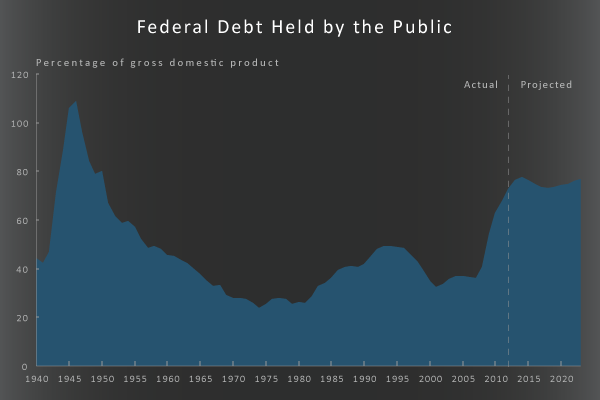
1. We don’t ever have to actually eliminate the debt: The United States ran up a huge debt burden in World War II. More importantly, in raw dollar terms, we never repaid that debt. We simply grew the economy so that the size of the debt fell in comparison. That’s what’s happening in graphs where the debt burden drops in the post-war years. That burden is measured as a ratio of debt-to-GDP, and in ratios the denominator matters as much as the numerator.

2. The budget doesn’t actually have to balance to reduce it: If we can keep deficits under a certain threshold every year, then economic growth will overtake it, meaning our debt-to-GDP ratio will either stay the same or even drop. For the immediate future, the economic looks set to grow by about 4 percent a year. If we can keep each year’s deficit to 4 percent or less of public debt already held, debt-to-GDP will stabilize. America can, in fact, run deficits in perpetuity.

3. The debt is already as balanced as it needs to be: Federal spending involves a host of programs called “stabilizers” — spending that automatically kicks in when the economy tanks, without any acts on the part of lawmakers, boosting GDP growth and helping Americans who have lost their jobs. These include unemployment insurance, food stamps, welfare, Medicaid, and many others. Tax revenues also naturally fall as unemployment rises.

The Congressional Budget office just released a report that stabilizers will add $422 billion to the deficit in 2013. That leaves $423 billion — out of the estimated $845 billion deficit for the year — that isn’t due to the automatic stabilizers. Publicly held U.S. debt is currently around $11.5 trillion, and $423 is less than 4 percent of that.

Take out the stabilizers, and the deficit is within the window necessary to stabilize the debt. And all we have to do to unwind the stabilizers is get the economy firing on all cylinders again. This holds true for about the next decade, before growth in Social Security, Medicare, and Medicaid finally begin to slowly overtake it. The country still has problems, but it has lots of time to sort them out.

4. The “debt crisis” is not a certainty: Paul Ryan may talk as if it is, but it’s merely a projection — one possible result if the CBO’s guesswork about the future proves accurate. The Center for American Progress recently dove into CBO’s methodology, and found that the projections build in a host of sometimes-dramatic assumptions about Congress’ future spending and taxation choices, as well as other factors that could very well not come to pass.

Beyond trying to predict future Congress’ policy preferences, much of the future debt is based on projections that health care costs will continue growing at their previous trend. But the whole point of health care reform is to alter that trend by altering health care markets. Obamacare may already be doing this. CBO’s projections for Medicare spending over the next decade dropped by $500 billion between 2010 and 2013, simply because health care cost growth unexpectedly slowed.

In fact, if that slowdown becomes the new norm, Medicare spending will stay essentially flat as a share of the economy from here on out. That doesn’t show up in CBO’s long-term projections because their methodology uses cost growth over the last two decades to predict future trends. (See page 60.) It’s literally within the realm of reasonable possibility that the long-term debt problem is already solved — all without lawmakers having to cut a dime.

5. We don’t know how much debt actually causes crisis: Ryan and others often cite a finding that economic growth slows as debt-to-GDP reaches 90 percent. But there’s a big correlation-causation problem with this. Remember the denominator: slowing GDP, regardless of debt, could raise debt-to-GDP just as much as higher debt could. And the countries that fit with the 90 percent threshold prediction also present an apples-to-oranges problem when compared to America. Britain, Japan, and France — advanced democracies like ours, with their own currency — shouldered debt levels far in excess of 90 precent over extended periods of time in the past. No debt crisis arrived.

In conclusion: the “debt crisis” is a mere phantom — only one of many possible futures, and far from a certainty. The interest America is paying on its debt is currently lower than it was in the 1990s, despite a lower debt-to-GDP ratio then. When inflation is factored in, current real interest rates on our debt are negative. Financial markets are willing to pay us to borrow from them.

Meanwhile, every dollar we cut — nay, every dollar we fail to borrow — is a dollar that isn’t going to shore up the safety net, to rebuild the country’s infrastructure, or to support struggling Americans while their livelihoods remain on the line. That we’re passing on this opportunity to repair our country, much less even considering the monstrosity that is the Ryan budget, really is absurd.


View the original article here

Monday, June 3, 2013

Why You Should Care About The Increasing Amount Of Fraud In Scientific Research

The Washington Post reported on the equivalent of an ongoing academic thriller unfurling at Johns Hopkins earlier this week, involving a researcher who alleges he was fired in retaliation for his criticism of flawed methodology — later used in an article published in Nature, one of most prestigious research journals — and the suicide of the primary author of the research while drafting a response to that criticism.

But while the full story remains to play out — Johns Hopkins refuses to comment and Nature has been quiet besides saying they expect to release a response in the future — this seedy tale can help bring one dark underbelly of the modern research world to light: How the academic politics of retraction and the pressure to publish may have an adverse effect on the quality of modern research.

A study published last year by Proceedings of the National Academy of Sciences noted that there has been a tenfold increase in scientific articles retracted due to fraud since 1975. Of the over 2000 biomedical and life-science retracted research articles studied, 21.3 percent of them were attributed to errors while 67.4 percent were due to researcher misconduct.  The Washington Post discussed the issue with one of the study’s authors, Ferric C. Fang:

“Fang said retractions may be rising because it is simply easier to cheat in an era of digital images, which can be easily manipulated. But he said the increase is caused at least in part by the growing competition for publication and for NIH grant money.

He noted that in the 1960s, about two out of three NIH grant requests were funded; today, the success rate for applicants for research funding is about one in five. At the same time, getting work published in the most esteemed journals, such as Nature, has become a “fetish” for some scientists, Fang said.”

While public funds support a majority of basic research in the U.S., those resources have been dwindling for years and took a significant hit in the sequester. That increase in competitiveness pressures researchers to present results, undoubtedly leading to some researchers falsifying their data in order to preserve their slice of the dwindling public research pie — also known as fraud. And when fraudulent research makes it through the publication process, it becomes part of the knowledge base built upon by other researchers around the world. For every fraudulent piece of research published, many more may rely on faulty grounding for future research projects, thus intellectually contaminating research areas with incorrectly drawn conclusions and impeding future advances.

The pitfalls of fraudulent research aren’t just theoretical: In the late 1990s, a medical researcher “misrepresented or altered the medical histories of all 12 of the patients” in a much-publicized study linking childhood vaccination to autism, in what some other researchers have called “the most damaging medical hoax of the last 100 years.” Between when the study was first came out and when it was disproved and retracted, there was a notable drop in youth vaccinations — which is bad for the health of our nation’s children, and the public at large.

Yet despite the severity of the problem and the great stakes at play, there is no centralized database to track these retractions — although new resources have emerged, like Retraction Watch, a blog run by two health journalists keeping tabs on the ongoing drama.


View the original article here

Some Unions Now Angry About Health Care Overhaul

WASHINGTON (AP) — When President Barack Obama pushed his health care overhaul plan through Congress, he counted labor unions among his strongest supporters.

But some unions leaders have grown frustrated and angry about what they say are unexpected consequences of the new law — problems that they say could jeopardize the health benefits offered to millions of their members.

The issue could create a political headache next year for Democrats facing re-election if disgruntled union members believe the Obama administration and Congress aren't working to fix the problem.

"It makes an untruth out of what the president said, that if you like your insurance, you could keep it," said Joe Hansen, president of the United Food and Commercial Workers International Union. "That is not going to be true for millions of workers now."

The problem lies in the unique multiemployer health plans that cover unionized workers in retail, construction, transportation and other industries with seasonal or temporary employment. Known as Taft-Hartley plans, they are jointly administered by unions and smaller employers that pool resources to offer more than 20 million workers and family members continuous coverage, even during times of unemployment.

The union plans were already more costly to run than traditional single-employer health plans. The Affordable Care Act has added to that cost — for the unions' and other plans — by requiring health plans to cover dependents up to age 26, eliminate annual or lifetime coverage limits and extend coverage to people with pre-existing conditions.

"We're concerned that employers will be increasingly tempted to drop coverage through our plans and let our members fend for themselves on the health exchanges," said David Treanor, director of health care initiatives at the Operating Engineers union.

Workers seeking coverage in the state-based marketplaces, known as exchanges, can qualify for subsidies, determined by a sliding scale based on income. By contrast, the new law does not allow workers in the union plans to receive similar subsidies.

Bob Laszewski, a health care industry consultant, said the real fear among unions is that "a lot of these labor contracts are very expensive and now employers are going to have an alternative to very expensive labor health benefits."

"If the workers can get benefits that are as good through Obamacare in the exchanges, then why do you need the union?" Laszewski said. "In my mind, what the unions are fearing is that workers for the first time can get very good health benefits for a subsidized cost someplace other than the employer."

However, Laszewski said it was unlikely employers would drop the union plans immediately because they are subject to ongoing collective bargaining agreements.

Labor unions have been among the president's closest allies, spending millions of dollars to help him win re-election and help Democrats keep their majority in the Senate. The wrangling over health care comes as unions have continued to see steady declines in membership and attacks on public employee unions in state legislatures around the country. The Obama administration walks a fine line between defending the president's signature legislative achievement and not angering a powerful constituency as it looks ahead to the 2014 elections.

Union officials have been working with the administration for more than a year to try to get a regulatory fix that would allow low-income workers in their plans to receive subsidies. But after months of negotiations, labor leaders say they have been told it won't happen.

"It's not favoritism. We want to be treated fairly," said Hansen, whose union has about 800,000 of its 1.3 million members covered under Taft-Hartley policies. "We would expect more help from this administration."

Sabrina Siddiqui, a Treasury Department spokeswoman, declined to discuss the specifics of any negotiations between the administration and union officials. But she said the law helps bring down costs and improve quality of care.

Katie Mahoney, executive director of health policy at the U.S. Chamber of Commerce, said employers were concerned about possible increases in health care costs and would do what was needed to keep their businesses running and retain worker talent. The Chamber has not taken a position on the union concerns, but Mahoney said it was highly unlikely that the administration would consider subsidies for workers in the union plans.

"They are not going to offset the expense of added mandates under the health care law, which employers and unions are going to pay for," Mahoney said.

Unions say their health care plans in many cases offer better coverage with broader doctors' networks and lower premiums than what would be available in the exchanges, particularly when it comes to part-time workers.

Unions backed the health care legislation because they expected it to curb inflation in health coverage, reduce the number of uninsured Americans and level the playing field for companies that were already providing quality benefits. While unions knew there were lingering issues after the law passed, they believed those could be fixed through rulemaking.

But last month, the union representing roofers issued a statement calling for "repeal or complete reform" of the health care law. Kinsey Robinson, president of the United Union of Roofers, Waterproofers and Allied Workers, complained that labor's concerns over the health care law "have not been addressed, or in some instances, totally ignored."

"In the rush to achieve its passage, many of the act's provisions were not fully conceived, resulting in unintended consequences that are inconsistent with the promise that those who were satisfied with their employer-sponsored coverage could keep it," Robinson said.

Harold Schaitberger, president of the International Association of Firefighters, said unions have been forceful in seeking solutions from the Obama administration, but none have been forthcoming. While Congress could address the problem by amending the health care law, Schaitberger said Senate Democrats told union leaders earlier this month that any new legislation was highly unlikely.

___

Follow Sam Hananel on Twitter: http://twitter.com/SamHananelAP


View the original article here